The Inscription of Ursus and ?
PHYSICAL DESCRIPTION
- Type
- Sarcophagus tablet.
- Material(s)
- Limestone.
- Execution
- Inscribed.
- Dimensions
- 49 × 59.5 cm
- Epigraphic Field
- 47 × 54 cm
- Letters Height
- 3.5-5 cm
Palaeographic comment
Dextrograde direction, horizontal orientation, vertical scale, and irregular ductus; left-aligned layout.
Inscription extremely difficult to read.
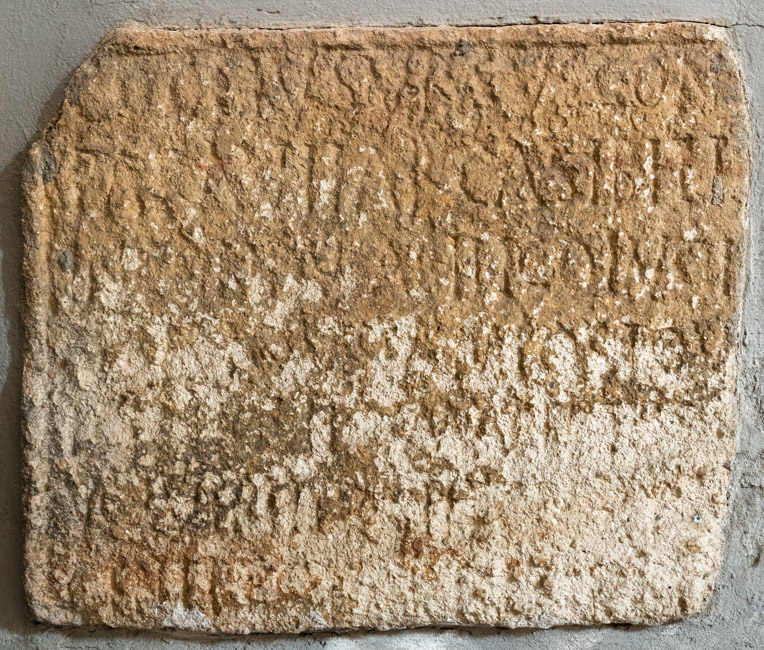
INSCRIPTION
INTERPRETATIVE TRANSCRIPTION
APPARATUS CRITICUS
1. CICRIVS, Bertolini 1876b,
.
3. [---] CONIVGI, Bertolini 1876b, Bertolini 1877,
.
4. [---]O, Bertolini 1876b, Bertolini 1877, Bertolini 1878
.
5. [---] APERIRE, Bertolini 1876b, Bertolini 1877,
CIL V 8685, Bertolini 1878
.
6-7. VOLVERIT [---]/[---], Bertolini 1876b,
CIL V 8685; VOLVERIT [---]/GENTI PONDO DECEM, Bertolini 1877; VOLVERIT [---]FAR/GENTI PONDO DECEM, Bertolini 1878
.
TRANSLATION
Cocceius Ursus purchased the sarcophagus for himself and for his incomparable spouse [---].
If anyone wishes to open it, he shall pay ten (roman) pounds of silver to the fiscus.
PEOPLE
Cocceius Ursus
- NOMEN
- Cocceius
- COGNOMEN
- Ursus
- GENS
- Cocceia
- ORIGIN (of the name Ursus)
- greek
- GENDER
- male
- OCCUPATION
- civilian
- ROLE
- dedicator/deceased
- RELATIONSHIP
- husband (→ ?)
?
- COGNOMEN
- ?
- GENDER
- female
- OCCUPATION
- civilian
- ROLE
- deceased
- RELATIONSHIP
- wife (→ Cocceius Ursus)
Bibliography
| Bertolini 1876b, 131, n. 4. |
| Bertolini 1877, 35, n. 46. |
| Bertolini 1878, 48. |
| CIL V 8685 |
| Lettich 1983, 99-100, n. 64. |
- EDR
-
EDR097845
- Author of the record:
- Damiana Baldassarra
- Date:
- 19-11-2007 29-04-2009
COMMENTARY
Cocceius Ursus commissioned the sarcophagus at his own expense for himself and his wife, whose name is illegible. Anyone who opened the sarcophagus would have to pay ten pounds of silver to the fiscus.
According to Lettich, this is the same Cocceius who buried his wife Decentia south of the road (Lettich 1983, 100; The Epigraphy of Ursus and Decentia). Cocceius, having outlived his first wife, would have remarried. This is not a unique case: Lettich cites the example of Romulianus, who was also widowed and remarried (Lettich 1983, 100).