The Inscription of Romulianus and Tahetis
PHYSICAL DESCRIPTION
- Type
- Frontal panel of the sarcophagus.
- Material(s)
- Limestone.
- Execution
- Inscribed.
- Dimensions
- 55.5 × 115 cm
- Epigraphic Field
- 47 × 97 cm
- Letters Height
- 4-5 cm
Palaeographic comment
Dextrograde direction, horizontal alignment, vertical module, irregular ductus, triangular interpunction, left-aligned layout.
F with crossbar shorter than the upper arm;
G without serif;
M composed of four oblique strokes.
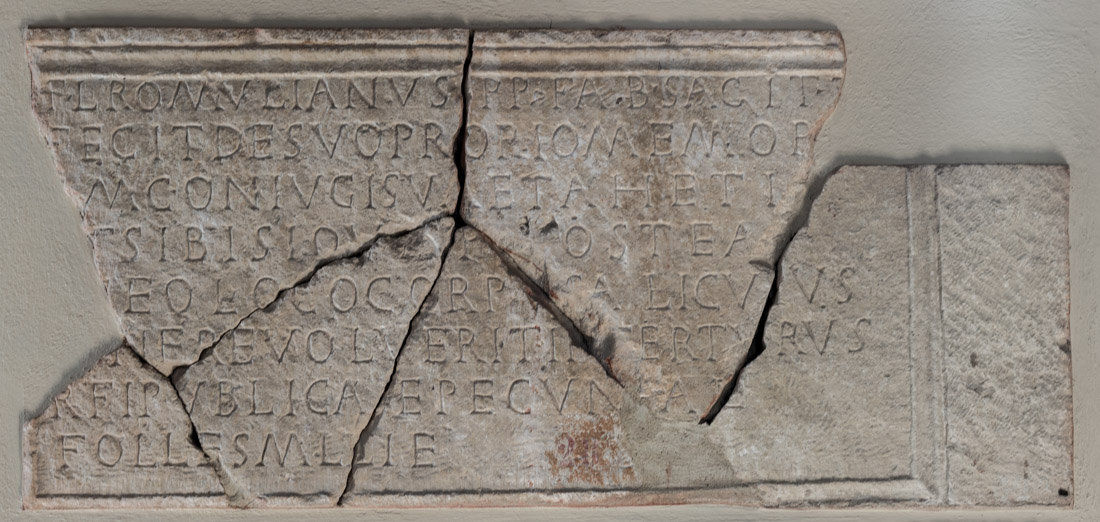
INSCRIPTION
INTERPRETATIVE TRANSCRIPTION
Fl(avius) Romulianus p(rae)p(ositus) fab(ricae) sagitṭ(ariae)
f̣ecit de suo pro<p>rio memoṛ[ia]
=
m coniugi suạe Taheti
[e]ṭ sibi. Si q̣ụ[i]s [p]ostea
in eo loco corpụs alicuius
poṇere voluerit inf̣ẹrtụrus
rei publicae pecun[i]ae
folles m<i>ll{i}e
APPARATUS CRITICUS
2. PROPIO, Lettich 1983
SV<A>E, Bertolini 1982; SV[A]E, Lettich 1983
.
7. PECVNIA, Lettich 1983
.
8. MILLE, Bertolini 1874a, Bertolini 1874b,
CIL V 8697,
ILCV 538 A; MILL{I}E, Lettich 1983
.
TRANSLATION
Flavius Romulianus, praepositus (superintendent) of the arrow factory, made this monument at his own expense for his wife Taheti and for himself.
If anyone afterwards wishes to place the body of another in this place, he shall pay to the public treasury one thousand folles.
PEOPLE
Flavius Romulianus
- NOMEN
- Flavius
- COGNOMEN
- Romulianus
- GENS
- Flavia
- ORIGIN (of the name Romulianus)
- latin
- GENDER
- male
- OCCUPATION
- fabricensis
- RANK
- praepositus
- ROLE
- dedicator/deceased
- RELATIONSHIP
- husband (→ Tahetis)
Tahetis
- COGNOMEN
- Tahetis
- ORIGIN (of the name Tahetis)
- egyptian
- GENDER
- female
- OCCUPATION
- civilian
- ROLE
- deceased
- RELATIONSHIP
- wife (→ Flavius Romulianus)
Bibliography
| Bertolini 1874a, 32, n. 28. |
| Bertolini 1874b, 294, n. 21. |
| CIL V 8697 |
| CIL V 8721 |
| Bertolini 1982, 44. |
| ILCV 538 A |
| Lettich 1983, 45-47, n. 1. |
- EDR
-
EDR097857
- Author of the record:
- Damiana Baldassarra
- Date:
- 21-11-2007
COMMENTARY
Flavius Romulianus, praepositus of the arrow factory in Concordia, commissions the tomb for his wife Tahetis and himself. Anyone who placed the corpse of someone else in this sarcophagus would have to pay the res publica one thousand folles.
Romulianus, as praepositus, was head of the arms factory. The same individual is mentioned in another epigraph found in the Persico estate where, again as dedicator, he commissions the burial for Aurelia Domnula. This is not the only evidence within the necropolis of a man who becomes widowed and remarries: consider the two inscriptions of Cocceius Ursus.
According to Lettich, Domnula would be the second wife of the fabricensis, since in this second epigraph it is written "ex p(rae)p(ositus)" and would therefore represent the retirement of Romulianus (Lettich 1983, 46-47). However, in the inscription found in the Persico estate, the intention of Romulianus to be buried with Domnula is not made explicit, unlike what is declared with his first wife Tahetis.
The name Tahetis is foreign to both Latin and Greek onomastics and probably has Egyptian origins (Lettich 1983, 46). According to Mommsen, in this context res publica would indicate the civitas Concordiensis ( CIL V, p. 1060). The folles were coins introduced by Diocletian that continued to be used until the middle of the 4th century (Lettich 1983, 46-47).