The Inscription of Ursus and Decentia
PHYSICAL DESCRIPTION
- Type
- Panel of the frontal slab of the sarcophagus.
- Material(s)
- Limestone
- Execution
- Inscribed.
- Dimensions
- 45.5 × 94 cm
- Epigraphic Field
- 41 × 84 cm
- Letters Height
- 4.5-6.5 cm
Palaeographic comment
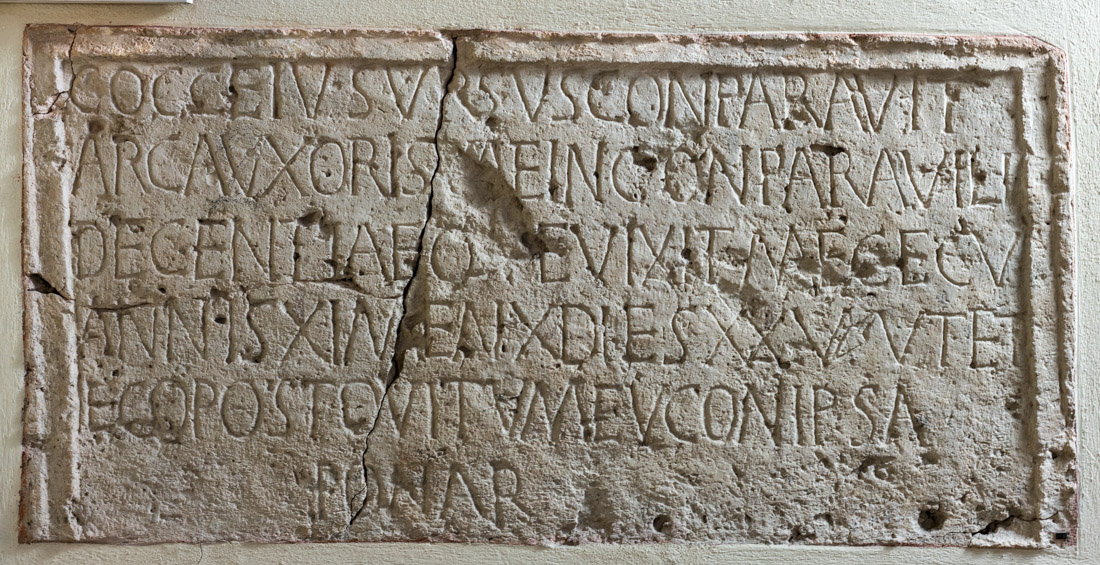
Dextrograde direction, horizontal orientation, vertical module, regular ductus, triangle-shaped punctuation, left-aligned layout.
The inscription features triangular apices (serifs) at the ends of the arms, in the shape of wolf-teeth (serrated motif).
The letter M is composed of four oblique strokes, whereas the first and third strokes of the N are vertical.
From a palaeographic perspective, this inscription is very similar to the nearby one belonging to Flavius Maximianus.
INSCRIPTION
INTERPRETATIVE TRANSCRIPTION
Cocceius Ursus conparavit (!)
arca (!) uxori sụạe inconparavili (!)
Decentiae, qụe (!) vixit me{ce}cu<m>
annis XI, men(sibus) X, die<bu>s XXV, ut et
ego post ovitu<m> (!) meu<m> con (!) ipsa
ponar.
APPARATUS CRITICUS
3. QVAE, Bertolini 1874a, Bertolini 1874b
.
TRANSLATION
Cocceius Ursus purchased the arca for his peerless wife Decentia, who lived with me for 11 years, 10 months, and 25 days, so that I too, after my death, may be laid to rest with her.
PEOPLE
Cocceius Ursus
- NOMEN
- Cocceius
- COGNOMEN
- Ursus
- GENS
- Cocceia
- ORIGIN (of the name Ursus)
- latin
- GENDER
- male
- OCCUPATION
- civilian
- ROLE
- dedicator/deceased
- RELATIONSHIP
- husband (→ Decentia)
Decentia
- COGNOMEN
- Decentia
- ORIGIN (of the name Decentia)
- latin
- GENDER
- female
- OCCUPATION
- civilian
- ROLE
- deceased
- RELATIONSHIP
- wife (→ Cocceius Ursus)
Bibliography
| Bertolini 1874a, 26, nr. 15. |
| Bertolini 1874b, 294, nr. 20. |
| CIL V 8736 |
| ILCV 844 |
| Lettich 1983, 100, nr. 65. |
- EDR
-
EDR097895
- Author of the record:
- Damiana Baldassarra
- Date:
- 22-11-2007
COMMENTARY
The gentilicium Cocceius likely dates back to the end of the 1st century AD. Its most famous representative is the Emperor Cocceius Nerva, but epigraphy confirms the existence of this nomen in the Veneto region during the Early Imperial period: a freedman named Marcus Cocceius lived in Altinum (CIL V 2217; CIL V 2218), and Cocceia Pompeia was buried in Aquileia (CIL V 1172).
However, the epigraph of Cocceius Ursus represents an interesting testimony because, as noted by Lettich (Lettich 1983, 100), it reveals the persistence of this gentilicium during Late Antiquity.
Lettich argues that this is the same Ursus buried north of the road with another spouse: he would have therefore remarried, perhaps failing to keep the promise of being buried with his first wife (Lettich 1983, 100).