The Inscription of Carpilio
PHYSICAL DESCRIPTION
- Type
- Frontal slab of the sarcophagus.
- Material(s)
- Limestone.
- Execution
- Inscribed.
- Dimensions
- 53 × 80 cm
- Epigraphic Field
- 53 × 80 cm
- Letters Height
- 4-6 cm
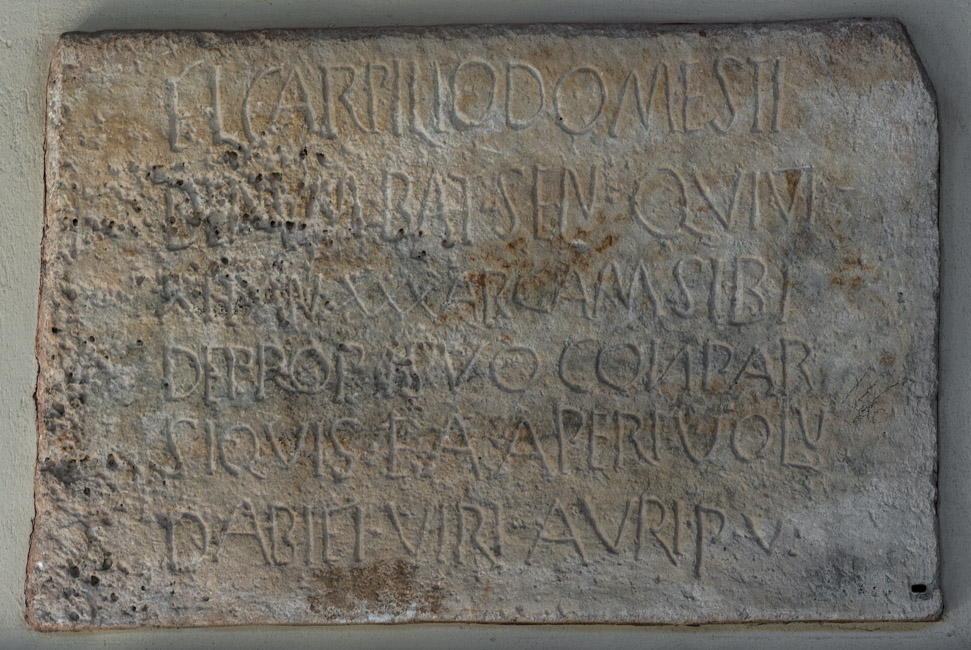
Palaeographic comment
Right-facing script, horizontal direction, vertical module, irregular ductus, left-aligned layout.
E is strongly compressed laterally.
F features an anomalous third arm developing at the base of the stem, making the F easily confused with E. The upper arm of the F is diagonal, ascending towards the right.
L with the lower arm diagonal, descending below the baseline.
N is retrograde (reversed) in line 4.
INSCRIPTION
INTERPRETATIVE TRANSCRIPTION
Fl(avius)
, domesti(cus)
de num(ero) Bat(avorum) sen(iorum), qui vi
=
xit an(nis) XXX, arcam sibi
de propi (!) suo conpar(avit) (!).
Si quis ea (!) aperi(re) volu(erit),
dabi(t) fi(sci) viri(bus) auri p(ondo) V.
APPARATUS CRITICUS
1. CAPRILIO, Bertolini 1877
.
TRANSLATION
Flavius Carpilio, domesticus of the numerus Batavorum seniorum, who lived thirty years, purchased this arca at his own expense.
If anyone should wish to open it, he shall pay five (roman) pounds of gold to the fiscus.
PEOPLE
Flavius Carpilio
- NOMEN
- Flavius
- COGNOMEN
- Carpilio
- GENS
- Flavia
- ORIGIN (of the name Carpilio)
- germanic
- GENDER
- male
- OCCUPATION
- soldier
- RANK
- domesticus
- NUMERUS
- Batavi Seniores
- ROLE
- dedicator/deceased
Bibliography
| Bertolini 1876a, 87, n. 6. |
| Bertolini 1877, 42, nr. 61. |
| CIL V 8743 |
| ILCV 480 |
| Hoffmann 1963, 39, nr. 16. |
| Lettich 1983, 80-81, nr. 36. |
- EDR
-
EDR097736
- Author of the record:
- Damiana Baldassarra
- Date:
- 25-11-2007
COMMENTARY
Flavius Carpilio was a thirty-year-old domesticus of the Batavi seniores. The role of the protectores domestici and their distinction from the simple protectores remains a debated issue to this day. Hoffmann, perhaps following Grosse, argues that the term domesticus, when referring to a soldier incorporated into a unit other than a schola protectorum domesticorum, should not be confused with the corps of the domestici proper, but rather indicates the rank of primicerius (Grosse 1920, 143; Hoffmann 1969, 79). However, no certain evidence seems to support this hypothesis; on the contrary, the domestici appear to have performed functions analogous to the simple protectores, distinguished from the latter by their greater prestige and closer proximity to the emperor (Jones 1963, 636; Lettich 1983, 81).
A significant portion of the domestici consisted of young sons of military commanders or high-ranking officials, sometimes of foreign origin. Such is the case of Hariulfus, son of Hanhavaldus of the Burgundian royal house, who was already a protector domesticus at the time of his death at only twenty years of age (Jones 1963, 638). Carpilio seems to fit perfectly into this context—a young man whose cognomen suggests a Gothic origin (Hoffmann 1970, 82, nt. 285).
In the necropolis of Concordia, another domesticus, Alatancus, and two protectores, Fandigildus and Iovinianus, are attested. To these is added the fragmentary inscription of the protector Fortunatus, found in the city but of unknown provenance (EDR098067). It is unlikely that these were members of the imperial escort who died during the Battle of the Frigidus, as they were affiliated with numeri rather than a central schola. Furthermore, the inscriptions themselves suggest a long-term residence: Alatancus commissioned the arca together with his wife Bitorta; the fragmentary epigraph of Fortunatus features a female name, Secundina; and Iovinianus was buried by his son and a relative (perhaps his father).
As Jones notes, the civil functions of these officers included the control of goods, to prevent products on the "prohibited list" (species prohibitae) from being exported to the barbaricum (Jones 1964, 636-637). Considering the presence of an important arrow factory in Concordia and the city's strategic role as a military and commercial hub, it is reasonable to hypothesize that protectores and domestici were permanently stationed there to oversee the production flow. Their task would have been to ensure the delivery of arrows to state warehouses and prevent illegal practices, such as under-the-counter sales to private merchants or the black market, which carried the risk of exporting these goods beyond the Empire's borders.