The Inscription of Alatancus and Bitorta
PHYSICAL DESCRIPTION
- Type
- Frontal slab of the sarcophagus.
- Material(s)
- Limestone.
- Execution
- Inscribed.
- Dimensions
- 60 × 116 cm
- Epigraphic Field
- 60 × 116 cm
- Letters Height
- 3.5-6 cm
Palaeographic comment
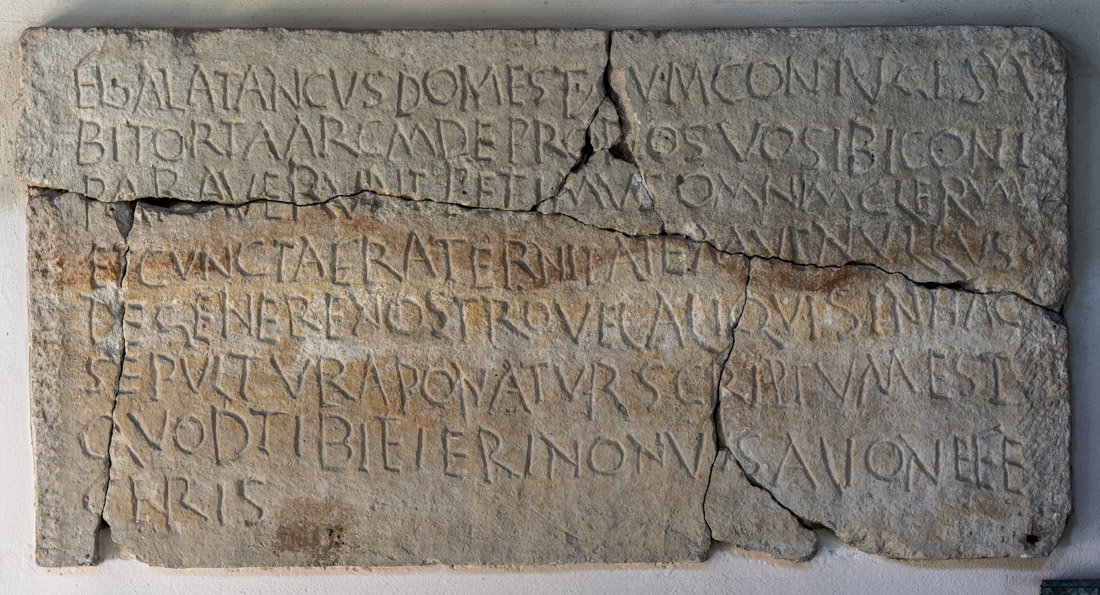
Dextrograde direction, horizontal alignment, square module, irregular ductus, deep groove, triangular interpunction, left-aligned layout.
E laterally compressed;
F laterally compressed with an anomalous lower arm below the crossbar, distinguished from E by its upper arm which is oblique and ascending to the right;
G without serif, with tail curving downward and touching the baseline;
L composed of a vertical stroke and a lower oblique stroke, descending to the right below the baseline;
L in FL(avius) with a third curving stroke, extending upward to the mid-height of the letter body;
M composed of four oblique strokes, with the central strokes intersecting at the baseline.
INSCRIPTION
INTERPRETATIVE TRANSCRIPTION
APPARATUS CRITICUS
2. BITOR[I]A,
CIL V 8738,
ILS 8257; ⸢V⸣I<C>TOR⸢I⸣A, Brusin, Zovatto 1960
ARCÂM, Bertolini 1876b,
CIL V 8738,
ILS 8257,
ILCV 476,
EDR097897
CON/PARAVERVNT, Bertolini 1874a
.
3. OMN<E>M, Bertolini 1874a
.
TRANSLATION
Flavius Alatancus, domesticus, with his wife Bitorta, built the sarcophagus from their own property for themselves.
We ask all the clergy and the whole brotherhood that no one of our family, nor anyone else, be placed in this burial.
It is written: what you do not wish to be done to you, do not do to another.
PEOPLE
Bitorta
- COGNOMEN
- Bitorta
- ORIGIN (of the name Bitorta)
- celtic
- GENDER
- female
- OCCUPATION
- civilian
- ROLE
- deceased
- RELATIONSHIP
- wife (→ Flavius Alatancus)
Flavius Alatancus
- NOMEN
- Flavius
- COGNOMEN
- Alatancus
- GENS
- Flavia
- GENDER
- male
- OCCUPATION
- soldier
- RANK
- domesticus
- NUMERUS
- unknown
- ROLE
- dedicator/deceased
- RELATIONSHIP
- husband (→ Bitorta)
Bibliography
| Bertolini 1874a, 28, nr. 22. |
| Bertolini 1876b, 130-131. |
| CIL V 8738 |
| ILS 8257 |
| ILCV 476 |
| . |
| Brusin, Zovatto 1960, 90. |
| Forlati Tamaro 1978, 147-148, nr. 2. |
| Lettich 1983, 60-62, nr. 19. |
- EDR
-
EDR097897
- Author of the record:
- Damiana Baldassarra
- Date:
- 22-11-2007
COMMENTARY
The soldier Flavius Alatancus commissioned, together with his wife, the sarcophagus intended to house the two spouses after death. Both entrusted themselves to the church of Concordia so that no one would violate the tomb by burying other individuals there. The prohibition is made explicit even for members of their own family, a unique case in all of Concordia, although there are burials where, on the contrary, it is expressly stated that family members were exempt from the prohibition of reusing the sarcophagus ( CIL V 8988e).
The second peculiarity is a literal quotation (scriptum est) from a passage in the life of Alexander Severus in the Historia Augusta: "quod tibi fieri non vis alteri ne feceris" (Hist. Aug., Alex. Sev., 51). The corps of protectores domestici, in addition to providing security service for the emperor, had to assist him in everything concerning the interest of the state (Amm. 15, 5, 22). Some of these positions of trust included training recruits, controlling traffic and customs, and military police duties (Lettich 1983, 61, 70-71).
The name Alatancus is considered Celtic by Holder (Holder 1896, 74), Germanic by Hoffmann (Hoffmann 1970, 32, nt. 271). According to Holder, Bitorta would have been erroneously written instead of Bitoria, which he considers a name of Celtic origin (Holder 1896, 430).