The Inscription of Fandigildus
PHYSICAL DESCRIPTION
- Type
- Frontal slab of the sarcophagus.
- Material(s)
- Limestone.
- Execution
- Inscribed.
- Dimensions
- 45 × 142 cm
- Epigraphic Field
- 45 × 142 cm
- Letters Height
- 6-7 cm
Palaeographic comment
Dextrograde direction, horizontal alignment, vertical module, irregular ductus, centered layout.
A with a diagonal crossbar, ascending to the right.
G with a long, diagonal bar, descending to the right.
L with the stem and the arm meeting above the baseline, forming an acute angle.
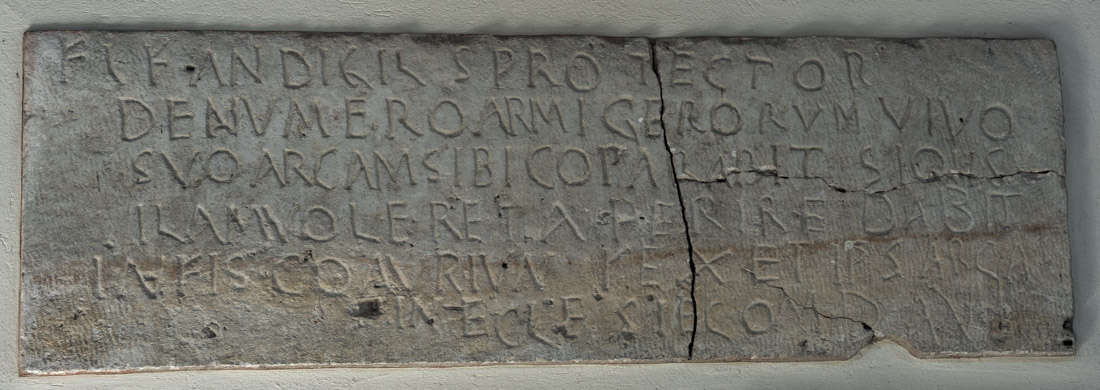
INSCRIPTION
INTERPRETATIVE TRANSCRIPTION
Fl(avius)
, protector
de numero armigerorum, vivo
<de> suo arcam sibi coparabit (!). Si qu<i>s
il<l>am vol<u>er⸢i⸣t aperire, dabit
in fisco auri un(cias) sex et ips(am) arca
in eclesie (!) com(men)dav(it).
APPARATUS CRITICUS
1. FANDICIL<V>S, Bertolini 1874a, Bertolini 1874b
.
3. CO(M)PARABIT,
EDR097745
OLIS, Bertolini 1874a; QIIS, Bertolini 1874b; QVIS,
CIL V 8747, Hoffmann 1963, Lettich 1983,
EDR097745
.
4. ILLAM, Bertolini 1874a, Bertolini 1874b
.
TRANSLATION
Flavius Fandigildus, protector of the numerus of the Armigeri, purchased [this] sarcophagus for himself with his own funds while still alive.
If anyone should wish to open it, they shall pay six (Roman) ounces of gold to the treasury and (Fandigildus) entrusted the sarcophagus itself to the (local) Church.
PEOPLE
Flavius Fandigildus
- NOMEN
- Flavius
- COGNOMEN
- Fandigildus
- GENS
- Flavia
- ORIGIN (of the name Fandigildus)
- germanic
- GENDER
- male
- OCCUPATION
- soldier
- RANK
- protector
- NUMERUS
- Armigeri Defensores Seniores
- ROLE
- dedicator/deceased
Bibliography
| Bertolini 1874a, 26, n. 16. |
| Bertolini 1874b, 288, nr. 9. |
| CIL V 8747 |
| ILCV 472 |
| Hoffmann 1963, 33-34, nr. 11. |
| Lettich 1983, 73-74, nr. 31. |
- EDR
-
EDR097745
- Author of the record:
- Damiana Baldassarra
- Date:
- 25-11-2007
COMMENTARY
Fandigildus was a protector of the numerus of the Armigeri.
The corps of the protectores, although formally constituting a single unit, was operationally dispersed among frontier commands and the staffs of the magistri militum (Jones 1964, 636); these detached protectores can be identified with the deputati of the Notitia Dignitatum (Jones 1964, 636). After Diocletian, the corps became a practical training school for future commanders, with its members distributed to various staffs as aides-de-camp and staff officers (Grosse 1920, 139).
The deceased fits into this framework as a protector deputatus operationally attached to the Armigeri, most likely the legio comitatensis Armigerorum defensorum seniorum, stationed in Gaul and attested in the Notitia Dignitatum under the command of the Magister Equitum (ND Occ. 5, 227; 7, 80). The identification with the Armigeri propugnatores, a palatine legion stationed in Africa (ND Occ. 5, 151, 156; 7, 142), appears geographically less plausible (Lettich 1983, 74).
The term armiger means "heavily armed" and could indicate a panoply heavier than average for this military unit, although no source explicitly supports this hypothesis.
In his capacity as protector, Fandigildus could likely claim the rank of perfectissimus (Grosse 1920, 143). His presence at Concordia, an important center for recruitment and deployment for the Late Roman army, is well explained by the typical duties of a protector in an operational context: overseeing and escorting recruits to headquarters, rounding up the sons of veterans attempting to evade enlistment, inspecting wagons on the roads, controlling goods in ports, and undertaking special missions on behalf of higher command (Jones 1964, 636-637). It remains an open question whether Fandigildus had been deputed to the Armigeri from the central corps, or if he was a veteran of the unit itself who had been awarded the title while remaining with his detachment—two conditions that the epigraphic titulary alone does not allow us to distinguish.
In addition to the common comminatory formula, Fandigildus entrusts his burial to the local Church, formulating the sermo in dedicatione ecclesiae, which is also present in the inscriptions of Alatancus and Bitorta and of Andia.