The Inscription of Zosimus
PHYSICAL DESCRIPTION
- Type
- Sarcophagus tablet.
- Material(s)
- Limestone.
- Execution
- Inscribed.
- Dimensions
- 41 × 82 cm
- Epigraphic Field
- 33 × 74 cm
- Letters Height
- 5-6 cm
Palaeographic comment
Dextrograde direction, horizontal layout, square module, irregular ductus, triangular punctuation, deep groove, centered layout.
A with vertical module.
E with vertical module.
Q with long tail, extended to the right below the baseline.
R with long tail, extended to the right below the baseline.
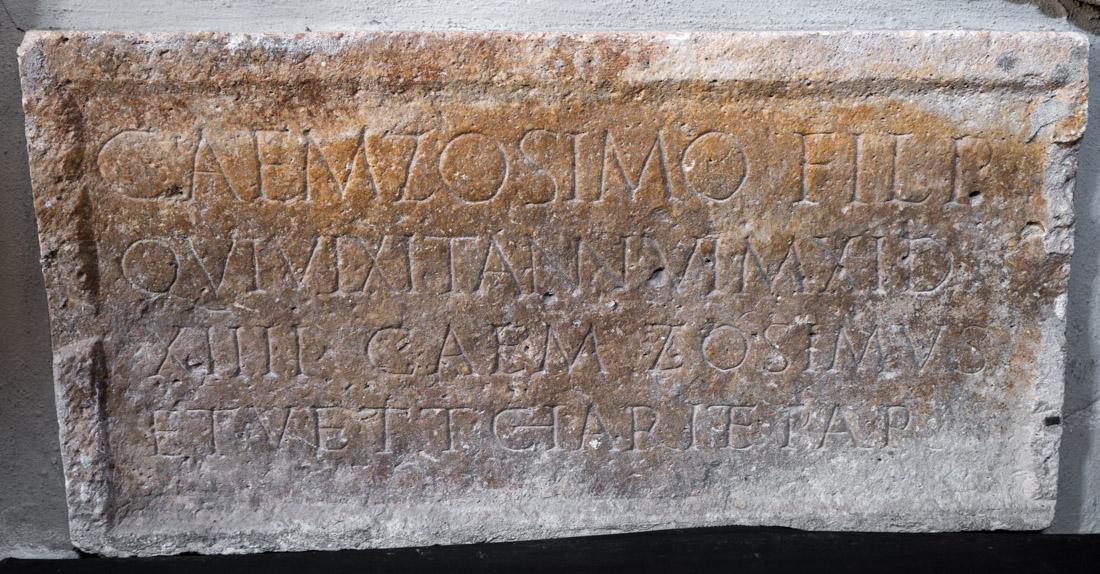
INSCRIPTION
INTERPRETATIVE TRANSCRIPTION
C(aio) Aem(ilio) Zosimo, fil(io) p(ientissimo?),
qui vixit an̂n(is) VI, m(ensibus) XI, d(iebus)
XIIII, C(aius) Aem(ilius) Zosimus
et Vett(ia) Ĉharit̂e par(entes).
TRANSLATION
To Caius Aemilius Zosimus, most dutiful son, who lived 6 years, 11 months, 14 days. Caius Aemilius Zosimus and Vettia Charite, his parents, [dedicated this].
PEOPLE
Caius Aemilius Zosimus
- PRAENOMEN
- Caius
- NOMEN
- Aemilius
- COGNOMEN
- Zosimus
- GENS
- Aemilia
- ORIGIN (of the name Zosimus)
- greek
- GENDER
- male
- OCCUPATION
- civilian
- ROLE
- deceased
- RELATIONSHIP
- son (→ Caius Aemilius Zosimus)
- RELATIONSHIP
- son (→ Vettia Charite)
Caius Aemilius Zosimus
- PRAENOMEN
- Caius
- NOMEN
- Aemilius
- COGNOMEN
- Zosimus
- GENS
- Aemilia
- ORIGIN (of the name Zosimus)
- greek
- GENDER
- male
- OCCUPATION
- civilian
- ROLE
- dedicator
- RELATIONSHIP
- father (→ Caius Aemilius Zosimus)
- RELATIONSHIP
- husband (→ Vettia Charite)
Vettia Charite
- NOMEN
- Vettia
- COGNOMEN
- Charite
- GENS
- Vettia
- ORIGIN (of the name Charite)
- greek
- GENDER
- female
- OCCUPATION
- civilian
- ROLE
- dedicator
- RELATIONSHIP
- mother (→ Caius Aemilius Zosimus)
- RELATIONSHIP
- wife (→ Caius Aemilius Zosimus)
Bibliography
| Bertolini 1876b, 131, n. 5. |
| Bertolini 1877, 30, n. 18. |
| CIL V 8687 |
| Lettich 1994, 264-265, n. 182. |
- EDR
-
EDR097834
- Author of the record:
- Damiana Baldassarra
- Date:
- 16-11-2007
COMMENTARY
Caius Aemilius Zosimus, together with his wife Vettia Charite, buried their son of the same name, who lived for six years, eleven months, and fourteen days.
The gens Aemilia is rarely attested in Concordia; the only other epigraphic occurrence, besides Zosimus, corresponds to the late antique inscription of Aemilia Apra. It is worth noting the loss of the diphthong -ae in this later period.
Conversely, the Vettii have been present in the city since the early Imperial age (EDR080127; CIL V 1895 = EDR097768). This nomen is also found in another inscription from the burial ground, belonging to Vettia Vitaliana.
The cognomina of both spouses are Greek and testify to their freedman status or origin (Lettich 1994, 265). The comminatory formula typical of more recent burials is missing.
The proximity of Zosimus' sarcophagus to the Cicrii tombs remains unclear: there seems to be no link between the two families.