The Inscription of Vitaliana and Severus
PHYSICAL DESCRIPTION
- Type
- Frontal slab of the sarcophagus.
- Material(s)
- Limestone.
- Execution
- Inscribed.
- Dimensions
- 50 × 117 cm
- Epigraphic Field
- 43 × 110 cm
- Letters Height
- 4,5-5 cm
Palaeographic comment
Dextrograde direction, horizontal layout, vertical module, irregular ductus, shallow incision.
The inscription is difficult to read: the stone was not smoothed prior to the cutting of the letters, and the incision is shallow.
E is strongly laterally compressed.
F with an anomalous lower stroke beneath the median bar, rendering it almost indistinguishable from E.
M composed of four oblique strokes.
N with oblique lateral strokes.
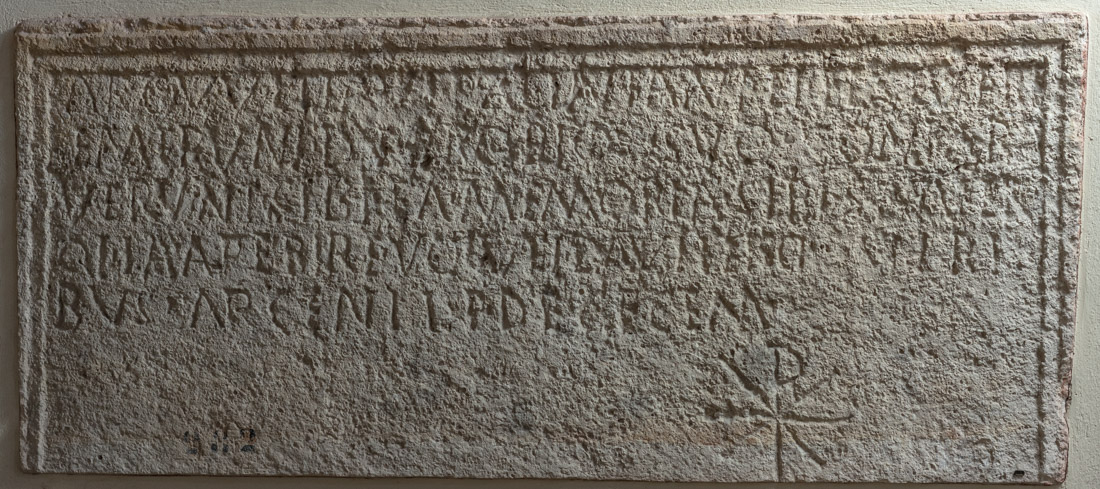
INSCRIPTION
INTERPRETATIVE TRANSCRIPTION
APPARATUS CRITICUS
1. ARCA[---], Bertolini 1874a, Bertolini 1874b; ARCVVETIA VITALINIANI ET FL SEVERI,
CIL V 8775,
EDR097923
; ARCVSELIA VITALINIANI ET FL SEVERI,
ILCV 716
.
2. [---] PROPRIO SVO CONPA/RAVERVNT SIBI [---], Bertolini 1874a, Bertolini 1874b
.
4. QVI APERIRE VOLV[---] VIRI/BVS, Bertolini 1874a, Bertolini 1874b
.
TRANSLATION
The arca of Vettia Vitaliana and Flavius Severus, they purchased with their own funds; they acquired it for my memorial. If anyone wishes to open it, they shall pay ten Roman pounds of silver to the fiscus.
PEOPLE
Vettia Vitaliana
- NOMEN
- Vettia
- COGNOMEN
- Vitaliana
- GENS
- Vettia
- ORIGIN (of the name Vitaliana)
- latin
- GENDER
- female
- OCCUPATION
- civilian
- ROLE
- dedicator/deceased
- RELATIONSHIP
- wife (→ Flavius Severus)
Flavius Severus
- NOMEN
- Flavius
- COGNOMEN
- Severus
- GENS
- Flavia
- ORIGIN (of the name Severus)
- latin
- GENDER
- male
- OCCUPATION
- civilian
- ROLE
- dedicator/deceased
- RELATIONSHIP
- husband (→ Vettia Vitaliana)
Bibliography
| Bertolini 1874a, 30, nr. 25. |
| Bertolini 1874b, 294, nr. 22. |
| CIL V 8775. |
| ILCV 716. |
| Lettich 1983, 106, nr. 79. |
| EDR097923. |
COMMENTARY
The initial formula is similar to that of the inscription of Vassio: the first word is the noun arcam, even though in this case the following names are in the genitive. The poorly executed letters and frequent orthographic mistakes make it difficult even to ascertain the number and names of the owners of the arca. There may have been three (arcam Vet(t?)ia(e), Vital{in}iani et Fl(avi) Severi), or only two, namely Vettia Vitaliana and Flavius Severus. I consider it more likely that there were two dedicators: many female individuals retained their dua nomina even during Late Antiquity; one example among many is the inscription on the nearby arca of Valeria Peregrina.
In any case, it is difficult to assume that the inscription refers to the cognomen Vitalinianus/Vitaliniana: consulting the corpora PIR² and PLRE and the EDR database, no evidence of such a name is found; it is probable that another syllable was inadvertently added, as also occurs in the fifth line with dece{ce}m. Lettich hypothesizes that the first person is named Flavius Vitalianus: he considers it plausible that the letter V was written instead of A, as occurs in other inscriptions, that E is in fact an F with an anomalous lower stroke beneath the crossbar, and that T is an L. However, this hypothesis is not compatible with my autoptic observation.
Note the formula memorialibus meis. Lettich argues that the noun memoriale was written in place of the common memoria, which in this context would indicate the tomb. Indeed, in the two inscriptions where it appears, the word memoria acquires a physical meaning that replaces the more common term arca. However, it is unclear why the word memoriale is declined in the plural. Moreover, this noun cannot replace the term arca, here already referred to by the pronoun ea(m). Furthermore, the personal pronoun meus seems inconsistent: noster would have been more appropriate, since the verbs ĕmo and compăro are conjugated in the third-person plural.
One should ask whether the names in the first line were the dedicators and whether the beneficiary in the inscription speaks in the first person. Perhaps the name of the deceased was inscribed on a side or on the lid of the sarcophagus, but Bertolini does not report the discovery of another inscription (Bertolini 1874, 29-30).