The Inscription of Vassio
PHYSICAL DESCRIPTION
- Type
- Sarcophagus.
- Material(s)
- Limestone.
- Execution
- Inscribed.
- Dimensions
- 115 × 197 × 93 cm
- Epigraphic Field
- 52 × 98 cm
- Letters Height
- 5-7 cm
Palaeographic comment
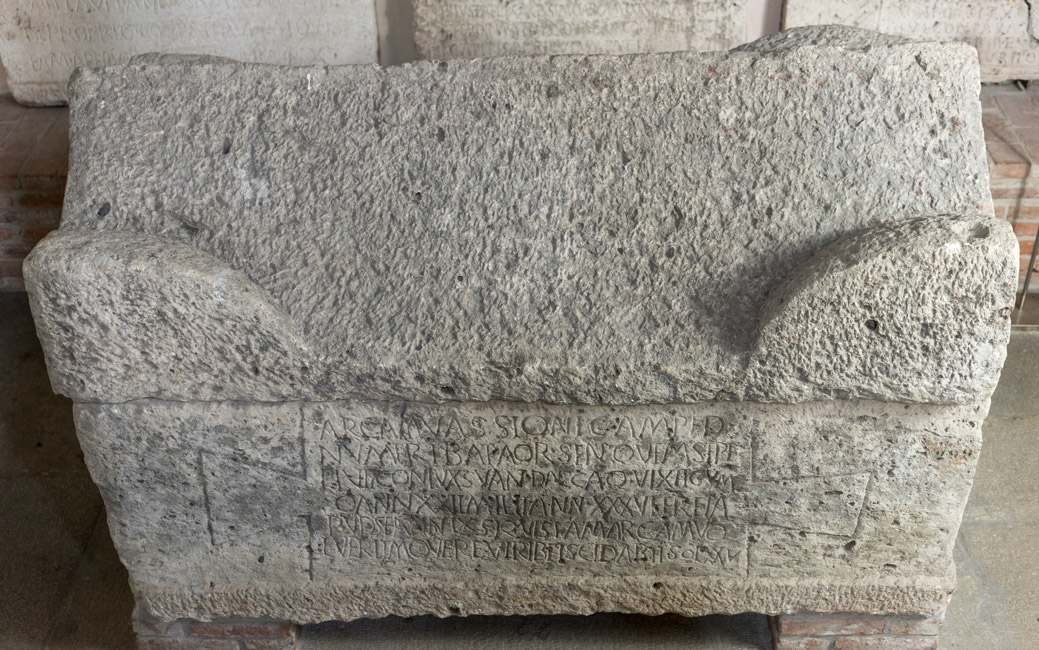
Dextrograde direction, horizontal layout, vertical module, irregular ductus, triangular-shaped interpunction, deep incision, centered layout.
A with a broken crossbar.
B whose lower loop is larger than the upper one.
E and F laterally compressed and both with three short strokes; the only distinguishing feature is the upper stroke, which in F is longer than the others and set obliquely, rising to the right.
L with a lower stroke that is oblique and descends to the right.
M formed by four oblique shafts; the two central shafts sometimes cross at the baseline, at other times they cross halfway up the body of the letter.
INSCRIPTION
INTERPRETATIVE TRANSCRIPTION
SIDE OF THE LID:
CHEST:
APPARATUS CRITICUS
1. CAMPED(OCTORI), Lettich 1983
.
3. CONIVX{S} VANDACCA,
ILCV 457
.
TRANSLATION
The tomb of Vassio, campidoctor of the numerus of the numbers of the Batavi seniores, who was buried by his wife Suandacca, who lived with him 22 years, served 35 years in the army, and reached the age of 60.
If anyone wishes to move this tomb, he shall pay twenty-five sesterces to the fiscus.
PEOPLE
Vassio
- COGNOMEN
- Vassio
- ORIGIN (of the name Vassio)
- celtic
- GENDER
- male
- OCCUPATION
- soldier
- RANK
- campidoctor
- NUMERUS
- Batavi Seniores
- ROLE
- deceased
- RELATIONSHIP
- husband (→ Suandacca)
Suandacca
- COGNOMEN
- Suandacca
- ORIGIN (of the name Suandacca)
- celtic
- GENDER
- female
- OCCUPATION
- civilian
- ROLE
- dedicator
- RELATIONSHIP
- wife (→ Vassio)
Bibliography
| Bertolini 1873a, 59. |
| Bertolini 1873b, 59. |
| CIL V 8773 |
| ILS 2803 |
| ILCV 457 |
| Hoffmann 1963, 41-42, 20. |
| Lettich 1983, 83-84, nr. 40. |
- EDR
-
EDR097921
- Author of the record:
- Damiana Baldassarra
- Date:
- 23-07-2008
COMMENTARY
Holder includes Vassio in his Corpus of Celtic personal names, but he does not exclude the possibility that it may instead be a Germanic name, coming from the Batavi or the Burgundians (Holder 1907, 121).
As for the wife, hers is a peculiar name, not attested elsewhere: Holder records both Suandacca and Vandacca, without being able to determine the correct reading (Holder 1904, 1649; Holder 1907, 98). The initial part of the name may derive from Breton *chwant*, meaning “desire” (Holder 1904, 1649).
The campidoctor had the role of training recruits and supervising work inside military camps (Grosse 1920, 126). Although Vegetius states that the centenarius performed a function similar to that formerly carried out by the centurio — “centuriones […] qui nunc centenarii nominantur” (Veget. II, 8) — Grosse considers the campidoctor the true successor of the centurio both in duties and hierarchical importance (Grosse 1920, 126).
Ammianus Marcellinus reports the promotion of a campidoctor to tribunus vacans, thus from NCO to officer (Amm. XV 3, 10); for this reason Grosse argues that the campidoctor was the highest position among the non-commissioned officers (Grosse 1920, 127).
According to Lettich, the presence of such an elderly campidoctor and the fact that he was buried by his wife would be indications of a prolonged stay in Concordia by the Batavi seniores.