The Inscription of Severina
PHYSICAL DESCRIPTION
- Type
- Frontal panel of the sarcophagus.
- Material(s)
- Limestone.
- Execution
- Inscribed.
- Dimensions
- 59.5 × 216 cm
- Epigraphic Field
- 45.5 × 121 cm
- Letters Height
- 7-10 cm
Palaeographic comment
Dextrograde direction, horizontal orientation, square module, and regular ductus; left-aligned layout.
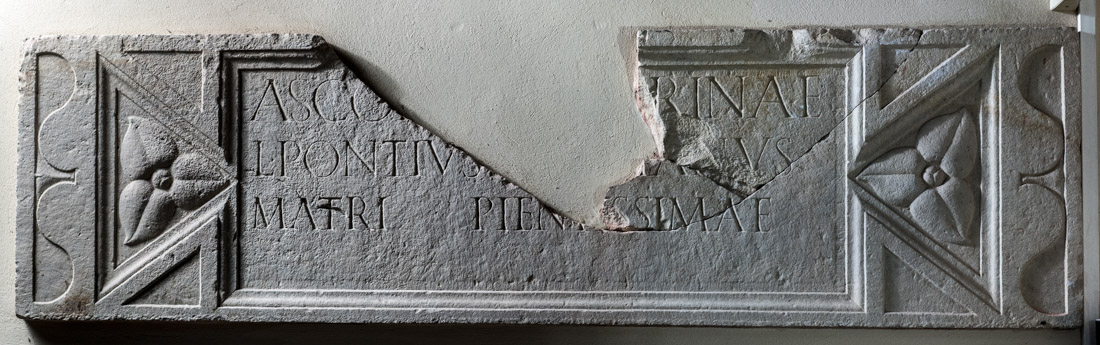
INSCRIPTION
INTERPRETATIVE TRANSCRIPTION
APPARATUS CRITICUS
1. ASCO[---], Bertolini 1876a, Bertolini 1877,
CIL V 8676
.
2. PONTIVS[---] CONIVGI, Bertolini 1876a, Bertolini 1877,
CIL V 8676
.
3. PIEN[---]AE, Bertolini 1876a, Bertolini 1877,
CIL V 8676
.
TRANSLATION
To Asconia Severina, Lucius Pontius [...]anus (set this up) for his most pious mother.
PEOPLE
Asconia Severina
- NOMEN
- Asconia
- COGNOMEN
- Severina
- GENS
- Asconia
- ORIGIN (of the name Severina)
- latin
- GENDER
- female
- OCCUPATION
- civilian
- ROLE
- deceased
- RELATIONSHIP
- mother (→ Lucius Pontius [---]anus)
Lucius Pontius [---]anus
- PRAENOMEN
- Lucius
- NOMEN
- Pontius
- COGNOMEN
- [---]anus
- NOMEN
- Pontia
- ORIGIN (of the name [---]anus)
- latin
- GENDER
- male
- OCCUPATION
- civilian
- ROLE
- dedicator
- RELATIONSHIP
- son (→ Asconia Severina)
Bibliography
| Bertolini 1876a, 86, n. 2. |
| Bertolini 1877, 29, n. 14. |
| CIL V 8676 |
| Lettich 1994, 252-254, n. 169. |
- EDR
-
EDR097836
- Author of the record:
- Damiana Baldassarra
- Date:
- 19-11-2007
COMMENTARY
Lucius Pontius dedicated the burial to his mother Asconia Severina. The cognomen of Pontius, though fragmentary, seems to derive from a gentilicium, as in the case of Fabianus; the suffix in -anus suggests that he may have been an adopted individual.
The gentilicium Pontius is rarely attested in Concordia: the only other occurrence (Bertolini 1877, 33, nr. 29 = CIL V 8704 = EDR097864) shows close paleographic and decorative affinities (tabula ansata) with the specimen under examination. No other attestations of the name Asconius are known in the city.
Based on the presence of the tria nomina and paleographic analysis, Brusin and Zovatto date the inscription to the 2nd century AD (Brusin, Zovatto 1960, 34), a dating confirmed by Lettich himself (Lettich 1994, 254). However, it is unlikely that such a monumentalized inhumation burial, far from the city, would be so ancient. In all likelihood, the inscription should be dated to the first half of the 3rd century AD, or at least not before the end of the 2nd century AD.