The Inscription of Fabianus
PHYSICAL DESCRIPTION
- Type
- Frontal panel of the sarcophagus.
- Material(s)
- Limestone.
- Execution
- Inscribed.
- Dimensions
- 46 × 174 cm
- Epigraphic Field
- 39 × 133 cm
- Letters Height
- 6-7.5 cm
Palaeographic comment
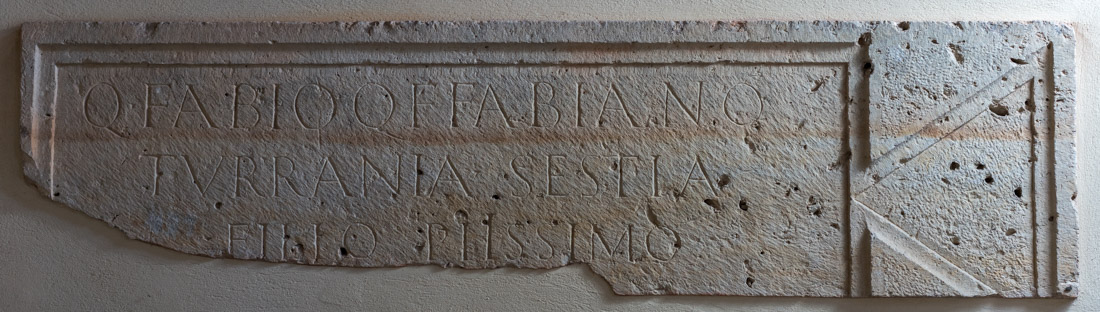
Dextrograde direction, horizontal orientation, square module, and regular ductus; centered layout.
INSCRIPTION
INTERPRETATIVE TRANSCRIPTION
Q(uinto) Fabio Q(uinti) f(ilio) Fabiano.
Turrania Sestia,
filio piissimo
TRANSLATION
To Quintus Fabius Fabianus, son of Quintus. Turrania Sestia, to (her) most pious son.
PEOPLE
Quintus Fabius Fabianus
- PRAENOMEN
- Quintus
- NOMEN
- Fabius
- COGNOMEN
- Fabianus
- GENS
- Fabia
- ORIGIN (of the name Fabianus)
- latin
- GENDER
- male
- OCCUPATION
- civilian
- ROLE
- deceased
- RELATIONSHIP
- son (→ Turrania Sestia)
Turrania Sestia
- NOMEN
- Turrania
- COGNOMEN
- Sestia
- NOMEN
- Turrania
- ORIGIN (of the name Sestia)
- latin
- GENDER
- female
- OCCUPATION
- civilian
- ROLE
- dedicator
- RELATIONSHIP
- mother (→ Quintus Fabius Fabianus)
Bibliography
| Bertolini 1875a, 115, n. 57. |
| Bertolini 1877, 29, n. 13. |
| CIL V 8692 |
| Lettich 1994, 265-266, n. 183. |
- EDR
-
EDR097852
- Author of the record:
- Damiana Baldassarra
- Date:
- 19-11-2007
COMMENTARY
The tria nomina and the patronymic represent the antiquity of the burial and the ingenuus status of the deceased. Another element testifying to the chronological priority of this ark compared to the late antique ones is the depth at which it was found, which made access difficult (Bertolini 1875a, 115). Fortunately, it was finally removed from the necropolis and is currently preserved in the Museo Nazionale Concordiese di Portogruaro.
Along with those of Fabia Paulina and Firmina, the sarcophagus of Fabianus represents one of the oldest inhumation burials in the entire necropolis. This group represents an important period of historical transition where the funerary rite of incineration began to be progressively abandoned due to the spread of mystery cults and the fashion for Oriental sarcophagi in the Hadrianic period (Croce Da Villa 2001b, 202). However, the first sarcophagi should likely be dated to the Severan age, or at least not before the late Antonine period.
The same Turrania Sestia was also mentioned on a now-lost inscription, where the mother buried another son, Quintus Fabius Caemianus (CIL V 1926). These two inscriptions commissioned by Sestia seem to be the earliest references to the presence of the gens Turrania in Concordia. In a later period, this gentilicium is found in the inscription commissioned by Turranius Honoratus, dedicated to his wife Aurelia Iovina. The writer Tirranio/Turranio Rufino, born in Concordia, also seems to have come from this family (Rohrbacher 2002, 93).