The Inscription of Marinus
PHYSICAL DESCRIPTION
- Type
- Frontal panel of the sarcophagus.
- Material(s)
- Limestone.
- Execution
- Inscribed.
- Dimensions
- 33 32 × 22 54 × 8 8,5 cm
- Epigraphic Field
- 33 32 × 22 54 cm
- Letters Height
- 4,5-5,5 cm
Palaeographic comment
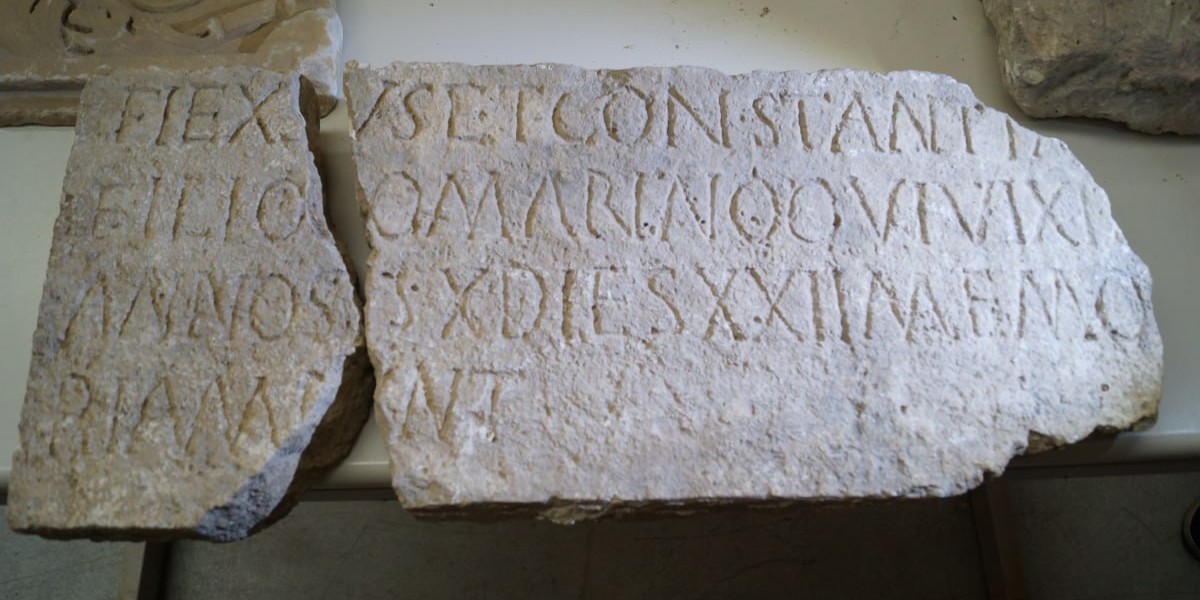
INSCRIPTION
INTERPRETATIVE TRANSCRIPTION
et Constantiạ
filio dulcissimo Marino, qui vixit
annos XVIII menses X, dies XXII, memo
=
riam dedicaverunt.
APPARATUS CRITICUS
1. FL(AVIVS), Bertolini 1874a, Bertolini 1874b,
CIL V 8746,
ILCV 3607, Lettich 1983,
EDR097744
EXSVPERANTIVS, Bertolini 1874a, Bertolini 1874b,
CIL V 8746,
ILCV 3607; EXVPERANTIVS, Lettich 1983; EXSVPERANTIVS,
EDR097744
XVII,
EDR097744
.
TRANSLATION
PEOPLE
Flavius Exsuperantius
- NOMEN
- Flavius
- COGNOMEN
- Exsuperantius
- GENS
- Flavia
- ORIGIN (of the name Exsuperantius)
- latin
- GENDER
- male
- OCCUPATION
- civilian
- ROLE
- dedicator
- RELATIONSHIP
- husband (→ Constantia)
- RELATIONSHIP
- father (→ Marinus)
Constantia
- COGNOMEN
- Constantia
- ORIGIN (of the name Constantia)
- latin
- GENDER
- female
- OCCUPATION
- civilian
- ROLE
- dedicator
- RELATIONSHIP
- wife (→ Flavius Exsuperantius)
- RELATIONSHIP
- mother (→ Marinus)
Marinus
- COGNOMEN
- Marinus
- ORIGIN (of the name Marinus)
- latin
- GENDER
- male
- OCCUPATION
- civilian
- ROLE
- deceased
- RELATIONSHIP
- son (→ Flavius Exsuperantius)
- RELATIONSHIP
- son (→ Constantia)
Bibliography
| Bertolini 1874a, 23, nr. 8. |
| Bertolini 1874b, 295, nr. 25. |
| CIL V 8746 |
| ILCV 3607 |
| Lettich 1983, 101, nr. 66. |
- EDR
-
EDR097744
- Author of the record:
- Damiana Baldassarra
- Date:
- 25-11-2007
COMMENTARY
The comminatory formula, typical of other inscriptions in the burial ground, is missing; in its place, the formula memoriam dedicaverunt is used.
The use of the word memoria in inscriptions is a tradition already present in the classical period and used in other inscriptions of the burial ground, such as the one dedicated to Eutherius.
According to Bertolini (Bertolini 1874a, 295-296), there may have existed in antiquity the Exsuperantia/Exuperantia family, to which Julius Exuperantius, the well-known epitomizer of Sallust (PLRE I, 321), also belonged. This family might have given rise to the Superantii, a fictitious genealogy from which the Soranzo family, part of the Venetian nobility, supposedly descended. This is certainly an erroneous conjecture: according to Kajanto, Exsuperantius was a cognomen and therefore could not refer to a gentilicium (Kajanto 1982, 277).