The Inscription of Eutherius
PHYSICAL DESCRIPTION
- Type
- Frontal panel of the sarcophagus.
- Material(s)
- Limestone.
- Execution
- Inscribed.
- Dimensions
- 52 × 85 cm
- Epigraphic Field
- × cm
- Letters Height
- 5.5-7.5 cm
Palaeographic comment
Dextrograde direction, horizontal alignment, vertical module, regular ductus, triangular interpunction, deep groove, left-aligned layout.
S and I undersized and vertically aligned in ami(s)sione;
F with lower arm shorter than the upper arm, unlike many other inscriptions where the lower arm of F is so long as to make the letter almost indistinguishable from E;
M composed of four oblique strokes;
Q with tail extending outside the letter body and horizontal at the baseline.
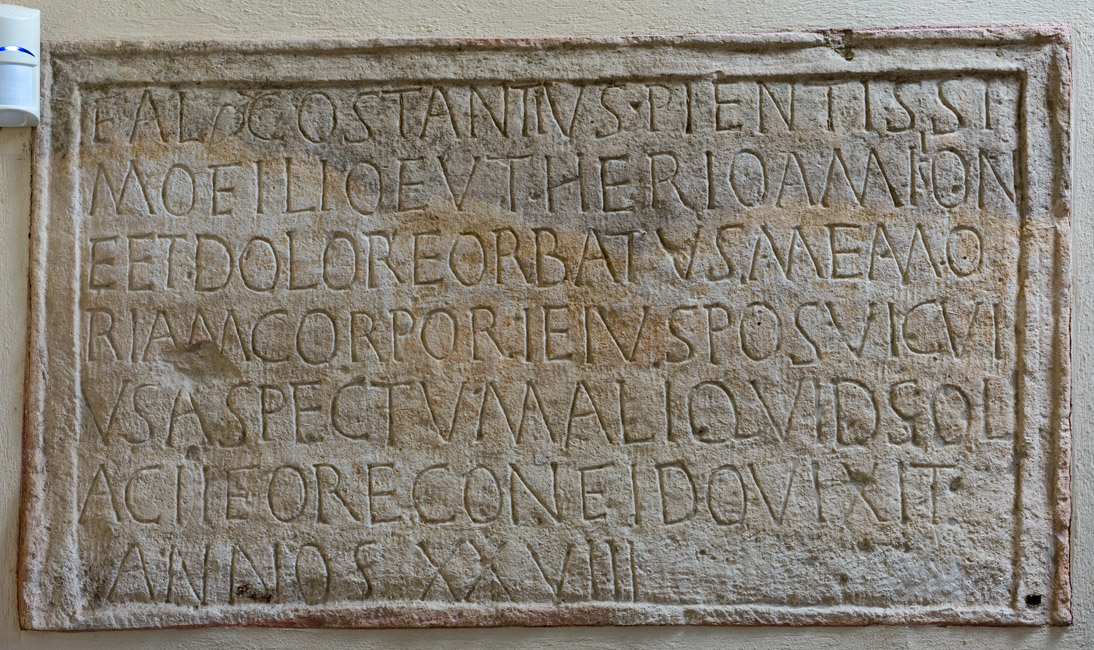
INSCRIPTION
INTERPRETATIVE TRANSCRIPTION
F{a}l(avius) Costantius, pientiss
=
mo filio Eutherio, ami‵s′<s>‵i′on
=
e et dolore orbatus, memo
=
riam corpori eius posui, cui
=
us asum aliquid sol
=
acii fore confido, vixit
annos XXVIII.
APPARATUS CRITICUS
2-3. AMISSION/E, Lettich 1983
.
TRANSLATION
Flavius Costantius, to his most devoted son Eutherius, bereft by loss and grief, have set up this memorial (sarcophagus) to his body, in the sight of which I trust there will be some solace. He lived twenty-eight years.
PEOPLE
Flavius Costantius
- NOMEN
- Flavius
- COGNOMEN
- Costantius
- GENS
- Flavia
- ORIGIN (of the name Costantius)
- latin
- GENDER
- male
- OCCUPATION
- civilian
- ROLE
- dedicator
- RELATIONSHIP
- father (→ Eutherius)
Eutherius
- COGNOMEN
- Eutherius
- ORIGIN (of the name Eutherius)
- oriental
- GENDER
- male
- OCCUPATION
- civilian
- ROLE
- deceased
- RELATIONSHIP
- son (→ Flavius Costantius)
Bibliography
| Bertolini 1877, 120, n. 3. |
| CIL V 8988d |
| ILCV 3606 |
| Lettich 1983, 105, n. 77. |
- EDR
-
EDR097934
- Author of the record:
- Damiana Baldassarra
- Date:
- 30-11-2007 01-01-2019
COMMENTARY
Flavius Costantius buries his son Eutherius, twenty-eight years old, trusting that the sight of the monument he commissioned for his son may comfort him.
The name Eutherius seems to have Eastern origins: a famous eunuch of the same name, a native of Armenia, was part of the court of Constantine and Constans and was subsequently appointed praepositus sacri cubiculi under Emperor Julian when the latter was still Caesar (PLRE, 314-315).
The use of the word memoria is also found in the epigraph dedicated to Marinus, paleographically similar to this inscription.