The Inscription of Dionisia_A
PHYSICAL DESCRIPTION
- Type
- Side of a sarcophagus.
- Material(s)
- Limestone.
- Execution
- Inscribed.
- Dimensions
- 43 × 56 cm
- Epigraphic Field
- 43 × 56 cm
- Letters Height
- 5-6 cm
Palaeographic comment
Dextrograde direction, horizontal alignment, vertical module, irregular ductus, no interpunctuation, shallow incision, centered layout.
A with a broken crossbar in the first line and with an oblique median in the subsequent lines
L with an oblique arm descending to the right.
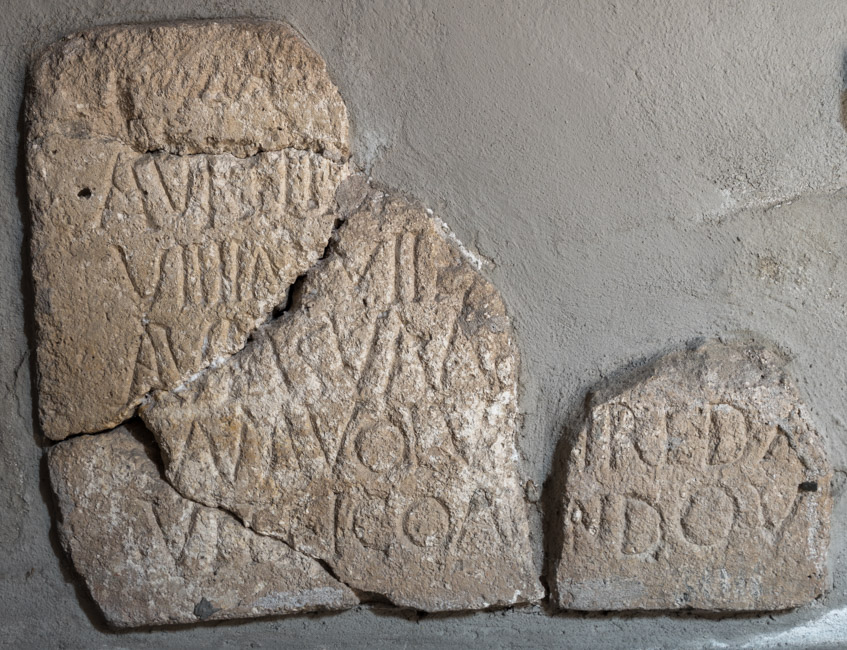
INSCRIPTION
INTERPRETATIVE TRANSCRIPTION
Auṛelia Di[onisia]
[quae vixit annis]
VIIII ṃ(ensibus) VII d(iebus) [---] cum
avia sua Ap[---] si quis
ẹam volu[erit aper]ire dạ
=
vit fi<s>co ar[genti p]ondo V
APPARATUS CRITICUS
1. DIV[---], Bertolini 1874a, Bertolini 1874b,
CIL V 8735; DIV[NISIA],
ILCV 817 A
[VIXIT ANNIS],
CIL V 8735,
ILCV 817 A
.
4. VOLVERIT [APER]IRE, Lettich 1983
.
TRANSLATION
Aurelia Dionisia, who lived 9 years, 7 months, [---] days, with her grandmother Ap[- - -].
If anyone wishes to open it (the sarcophagus), they shall pay the fiscus 5 pounds of silver.
PEOPLE
Aurelia Dionisia
- NOMEN
- Aurelia
- COGNOMEN
- Dionisia
- GENS
- Aurelia
- ORIGIN (of the name Dionisia)
- greek
- GENDER
- female
- OCCUPATION
- civilian
- ROLE
- deceased
- RELATIONSHIP
- granddaughter (→ Ap[---])
Ap[---]
- NOMEN
- Aurelia?
- COGNOMEN
- Ap[---]
- GENS
- Aurelia?
- ORIGIN (of the name Ap[---])
- latin?
- GENDER
- female
- OCCUPATION
- civilian
- ROLE
- dedicator
- RELATIONSHIP
- grandmother (→ Aurelia Dionisia)
Bibliography
| Bertolini 1874a, 27, nr. 18. |
| Bertolini 1874b, 295, nr. 24. |
| CIL V 8735 |
| ILCV 817 A |
| Lettich 1983, 106-107, nr. 80. |
- EDR
-
EDR097894
- Author of the record:
- Damiana Baldassarra
- Date:
- 23-07-2008
COMMENTARY
Aurelia Dionisia is addressed in another fragmentary inscription on a nearby sarcophagus, since both her age and the initials of her cognomen coincide.
It is not clear why two sarcophagi would have been dedicated to Dionisia. Mommsen, attempting to resolve this issue, maintains that both inscriptions belonged to the same arca: this inscription would have been on one of the sides of the sarcophagus, while the second on its front.
However, Bertolini does not report this version and, according to the site plan, the inscriptions in question were located on two distinct arcae, although close to one another.
Perhaps Dionisia’s first sarcophagus had been damaged or subsequently occupied by others, or her body had initially been placed in a temporary arca intended for other members of the family—reasons that would have made it necessary to move her remains to another arca.
Indeed, the inscription of Ennius Cerealis shows that tombs were at times cared for and restructured by relatives.