The M is formed by four oblique strokes; the two central strokes intersect on the baseline.
The O is of reduced size.
The R displays a small, square-shaped bowl, with the tail set high in relation to the body of the letter.
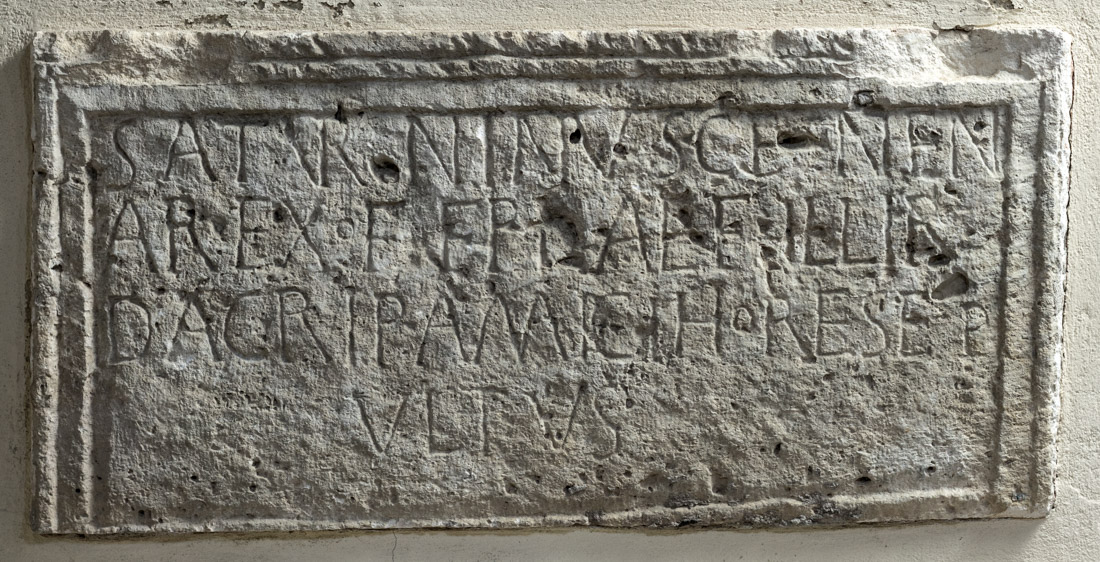
The iscription of Saturninus. Museo Nazionale Concordiese, Portogruaro; photo by Ortolf Harl (Ubi Erat Lupa). Courtesy of the Ministry of Culture - Regional Directorate of National Museums of Veneto. Any commercial or for-profit use of these images is strictly prohibited and must be subject to a specific authorization request to the Regional Directorate of National Museums of Veneto.
Saturninus, centenarius serving in the office of the prefect of Illyricum of Dacia Ripensis, buried for the honour (?) of a friend (?).
COMMENTARY
In this context, the term centenarius does not denote a military rank, but rather a civil official (Hoffmann 1969, 63). The designation originated in the Middle Imperial period to identify a category of officials receiving an annual salary of one hundred thousand sesterces, and it continued to be used even after this monetary unit had fallen into disuse (Lettich 1983, 55).
The prefecture mentioned in the inscription is less clearly identifiable. According to Hoffmann, it cannot refer to the Praetorian Prefecture of Italy, Illyricum, and Africa, since in such a case the abbreviated title would have been praefectus Italiae(Hoffmann 1969, 90), nor to the prefecture of Eastern Illyricum. He instead proposes a short-lived prefecture established when Illyricum was fully incorporated into the pars Orientis, within a chronological framework spanning from 392 to 396 AD (Hoffmann 1969, 90–91).
Hoffmann further argues that officials originating from the Eastern Roman Empire would scarcely have travelled to Italy except in connection with an administrative reorganization following a major historical event, which he identifies as the Battle of the Frigidus, fought in September 394 AD (Hoffmann 1969, 91). Saturninus, therefore, prior to his arrival at Concordia, is likely to have held office in Dacia Ripensis, a territorial division within the prefecture of Illyricum (CIL V, p. 1060).
COMMENTARY
In this context, the term centenarius does not denote a military rank, but rather a civil official (Hoffmann 1969, 63). The designation originated in the Middle Imperial period to identify a category of officials receiving an annual salary of one hundred thousand sesterces, and it continued to be used even after this monetary unit had fallen into disuse (Lettich 1983, 55).
The prefecture mentioned in the inscription is less clearly identifiable. According to Hoffmann, it cannot refer to the Praetorian Prefecture of Italy, Illyricum, and Africa, since in such a case the abbreviated title would have been praefectus Italiae (Hoffmann 1969, 90), nor to the prefecture of Eastern Illyricum. He instead proposes a short-lived prefecture established when Illyricum was fully incorporated into the pars Orientis, within a chronological framework spanning from 392 to 396 AD (Hoffmann 1969, 90–91).
Hoffmann further argues that officials originating from the Eastern Roman Empire would scarcely have travelled to Italy except in connection with an administrative reorganization following a major historical event, which he identifies as the Battle of the Frigidus, fought in September 394 AD (Hoffmann 1969, 91). Saturninus, therefore, prior to his arrival at Concordia, is likely to have held office in Dacia Ripensis, a territorial division within the prefecture of Illyricum (CIL V, p. 1060).