The Inscription of Optata
PHYSICAL DESCRIPTION
- Type
- Frontal slab of the sarcophagus.
- Material(s)
- Limestone
- Execution
- Inscribed.
- Dimensions
- 37 × 94 cm
- Epigraphic Field
- 37 × 94 cm
- Letters Height
- 4-6 cm
Palaeographic comment
Dextrograde direction; horizontal alignment; vertical and irregular module; irregular ductus; light incision, triangle-shaped punctuation.
The letter A shows a broken crossbar.
The letter F features an oblique top bar, ascending towards the right.
The letter E has three short arms and is difficult to distinguish from the letter I.
The letter L features an oblique lower arm that drops below the baseline.
The letter M is composed of four oblique strokes.
The letter N is composed of three oblique strokes.
The text ends with an hedera distinguens.
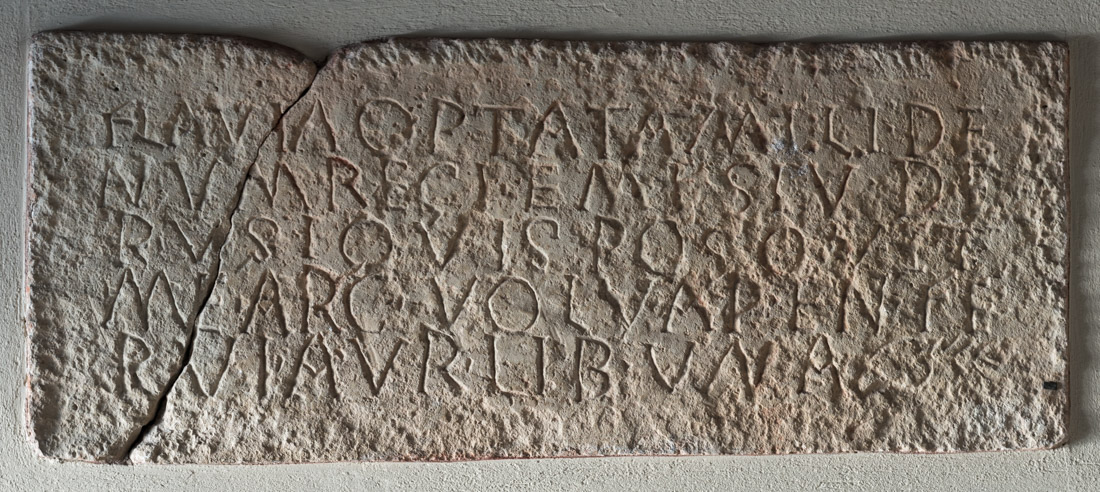
INSCRIPTION
INTERPRETATIVE TRANSCRIPTION
APPARATUS CRITICUS
2-3. EMES(ENORVM) IVDEO /RV(M),
CIL V 8764; EMES(ENORVM) IVD(A)E(O) /RV(M), Hoffmann 1963; EMES(ENORVM) IVD(A)E(O) /RV<M>, Lettich 1983
.
4. <I>NFE,
CIL V 8764
.
TRANSLATION
Flavia Optata, miles of the numerus of the Regii, purchased (this sarcophagus) for herself with the funds (of her husband?).
If anyone after my death should wish to open the arca, they shall pay to the resources (of the fiscus?) one (roman) pound of gold.
PEOPLE
Flavia Optata
- NOMEN
- Flavia
- COGNOMEN
- Optata
- GENS
- Flavia
- ORIGIN (of the name Optata)
- latin
- GENDER
- female
- OCCUPATION
- civilian
- ROLE
- dedicator/deceased
Bibliography
| Bertolini 1874a, 29, nr. 23. |
| Bertolini 1874b, 290, nr. 12. |
| CIL V 8764 |
| ILCV 4857 |
| Hoffmann 1963, 50-51, nr. 36. |
| Scarpa Bonazza Buora Veronese 1978, 70. |
| Lettich 1983, 95-96, nr. 57. |
| Speidel 1996, 164. |
| Ameling 2019, 187-188. |
- EDR
-
EDR097912
- Author of the record:
- Damiana Baldassarra
- Date:
- 26-11-2007 06-10-2020
COMMENTARY
The inscription, which is difficult to read and interpret, testifies to the burial of Flavia Optata, a woman who would belong to a numerus. Mommsen (CIL V 8764) and Diehl (ILCV 4857) believed that the name of the husband, to whom the noun militis would refer, had been forgotten.
On the contrary, Hoffmann did not consider it plausible that the husband's name had been omitted by mistake; Flavia Optata would therefore be the miles of that numerus: according to the scholar, at this time the wives and children of soldiers were considered members of the same military unit as the husband or father (Hoffmann 1963, 50). Given the absence of the soldier's name, Hoffmann considers it more likely that Optata was a concubine or a daughter (Hoffmann 1963, 50).
The unit to which the text refers is also unclear. Mommsen, Diehl, and Hoffmann argue that the epigraph alludes to the numerus Regiorum Iudeorum Emensorum (CIL V 8764 - ILCV 4857), and Lettich also reports the same integration, albeit reluctantly (Lettich 1983, 95-96). This unit is not attested by any source, not even by the Notitia dignitatum, which only cites the legio comitatensis of the Regii stationed in Italy (ND occ. 5, 229; 7, 32.) and the auxilium palatinum of the same name included in the eastern army (ND or. 6, 49.).
Hoffmann defended the existence of the Regii Iudei Emensi, claiming that there had been a correction by a later scribe who, considering the law of Honorius and Theodosius II of March 10, 418 AD, which prohibited the recruitment of Jews (C. Th. 16, 8, 24.), would have modified the name of the unit, leaving only the word Regii. However, Tomlin asserts that the Notitia dignitatum shows no changes later than 395 AD (Tomlin 1972, 270.). Furthermore, Hoffmann's version would not explain the omission of the Emensi.
Even Lettich considers it unlikely that a military unit was composed exclusively or predominantly of Jews even in the period preceding the aforementioned law (Lettich 1983, 96). Speidel noted that the Regii did not come from Emesa nor were they Jews and, comparing it with the formula present in other sarcophagi where it is declared that the burial was paid for at one's own expense (arcam emit sibi de proprio), he argues that Optata commissioned her own sarcofagus with her husband's money (Speidel 1996, 165.).
Speidel's criticism of the supposed existence of the Regii Emensi Iudei is shared by Ameling (Ameling 2019, 188). The beneficiary of the payment of the fine is not clear but, considering the other inscriptions of the burial ground, it is likely the fiscus.