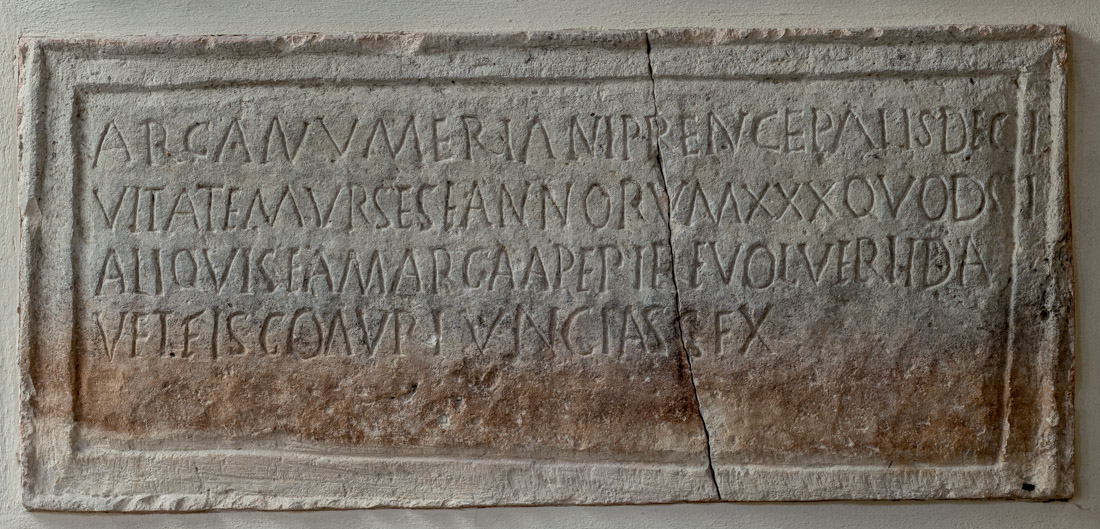
The iscription of Numerianus. Museo Nazionale Concordiese, Portogruaro; photo by Ortolf Harl (Ubi Erat Lupa). Courtesy of the Ministry of Culture - Regional Directorate of National Museums of Veneto. Any commercial or for-profit use of these images is strictly prohibited and must be subject to a specific authorization request to the Regional Directorate of National Museums of Veneto.
INSCRIPTION
INTERPRETATIVE TRANSCRIPTION
Arca Numeriani pr⸢i⸣ncipalis de ci
=vitate Murse<n>se, annorum XXX, quod si
aliquis eam arca (!) aperire voluerit, da
=vet (!) fisco auri uncias sex.
Numerianus was a principalis, an honorary rank which, in Late Antiquity, did not correspond to a specific office but was conferred upon members of local curiae.
Numerianus came from the city of Mursa in Pannonia, today’s Esseg-Osijek.
According to Hoffmann, Numerianus travelled to Concordia in the retinue of Theodosius, together with Saturninus, for the same purpose: to reorganize the territory after the Battle of the Frigidus.
If Hoffmann’s hypothesis is accepted, the inscription would date to 394 AD or to the years immediately following. However, the paleographic features of the letterforms seem to suggest an earlier date.
COMMENTARY
Numerianus was a principalis, an honorary rank which, in Late Antiquity, did not correspond to a specific office but was conferred upon members of local curiae.
Numerianus came from the city of Mursa in Pannonia, today’s Esseg-Osijek.
According to Hoffmann, Numerianus travelled to Concordia in the retinue of Theodosius, together with Saturninus, for the same purpose: to reorganize the territory after the Battle of the Frigidus.
If Hoffmann’s hypothesis is accepted, the inscription would date to 394 AD or to the years immediately following. However, the paleographic features of the letterforms seem to suggest an earlier date.