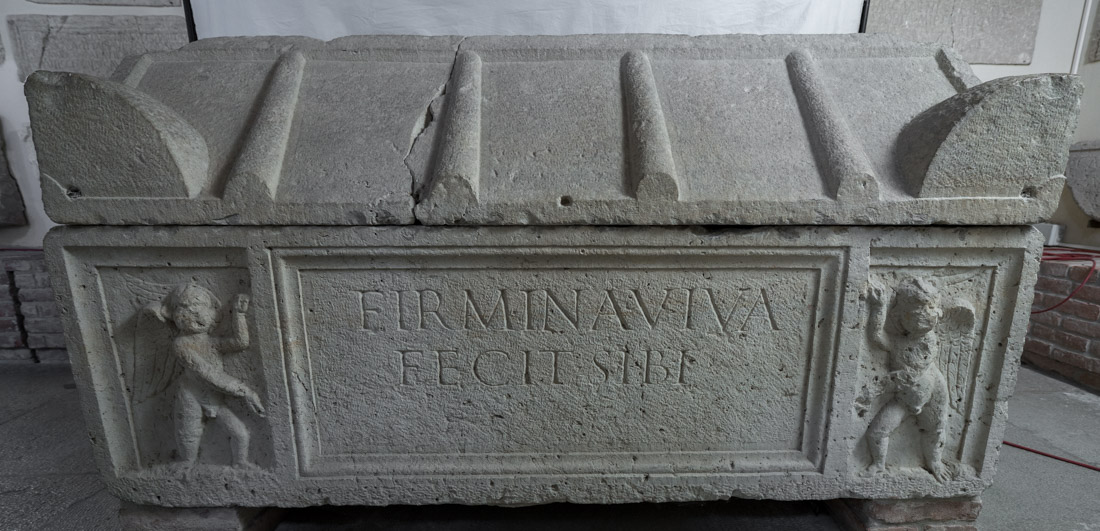
The sarcophagus of Firmina. Museo Nazionale Concordiese, Portogruaro; photo by Ortolf Harl (Ubi Erat Lupa). Courtesy of the Ministry of Culture - Regional Directorate of National Museums of Veneto. Any commercial or for-profit use of these images is strictly prohibited and must be subject to a specific authorization request to the Regional Directorate of National Museums of Veneto.
INSCRIPTION
INTERPRETATIVE TRANSCRIPTION
Firmina viva
fecit sibi.
TRANSLATION
Firmina commissioned (this tomb) for herself while alive.
COMMENTARY
The absence of the nomen in the inscription seems to indicate the servile status of the deceased, although it appears unlikely that a slave could have afforded such an expensive sarcophagus.
Brusin hypothesizes the existence of a burial area of the gens Fabia(Brusin 1960, 59), to which the tomb of Firmina might belong: this would explain the omission of the gentilic name on the inscription, considered a pleonasm since it was already present on the main monument, a view shared by Buora (Buora 1984, 46-47). However, according to Lettich, there is insufficient evidence to demonstrate the existence of a common burial area for members of this family (Lettich 1994, 264).
Although the dating of the sarcophagus and its figurative program suggest the deceased’s pagan faith, it cannot be excluded that she was Christian and that the absence of the nomen reflected her intention not to claim familial ties, in order to fully identify with the Christian community. Two sarcophagi found in Concordia, on Via San Pietro, show a similar onomastic pattern: in the first case only the praenomen and cognomen of the dedicant Publius Firmiteius (EDR156657) are recorded, while in the other only those of the deceased Publius Impostor (EDR098072), showing that the nomen was deliberately omitted.
The presence of the praenomen in these cases is linked to the male sex of the individuals, who intended to assert their non-servile status while omitting the gentilizio in order to identify exclusively with the Christian community (Calvelli 2015, 92-93), a choice probably shared by Firmina.
Note that in one of the two inscriptions the dedicant bears the cognomen Firmiteius, which he shares with Firmina through the root firmitas, a concept recurrent in patristic literature and a symbol of the firmness of Christian faith (Calvelli 2015, 93-94).
Although Firmina’s sarcophagus does not bear Christian symbols but rather winged geni linked to the pagan world, it should be noted that Christians often did not attribute religious meaning to certain formal elements: for example, two letters dedicating the tomb to the gods Mani appear on the sarcophagus of Firmiteius and in the bisoma burial of Flavius Martinianus and Severina, which also contained a Constantinian monogram.
COMMENTARY
The absence of the nomen in the inscription seems to indicate the servile status of the deceased, although it appears unlikely that a slave could have afforded such an expensive sarcophagus.
Brusin hypothesizes the existence of a burial area of the gens Fabia (Brusin 1960, 59), to which the tomb of Firmina might belong: this would explain the omission of the gentilic name on the inscription, considered a pleonasm since it was already present on the main monument, a view shared by Buora (Buora 1984, 46-47). However, according to Lettich, there is insufficient evidence to demonstrate the existence of a common burial area for members of this family (Lettich 1994, 264).
Although the dating of the sarcophagus and its figurative program suggest the deceased’s pagan faith, it cannot be excluded that she was Christian and that the absence of the nomen reflected her intention not to claim familial ties, in order to fully identify with the Christian community. Two sarcophagi found in Concordia, on Via San Pietro, show a similar onomastic pattern: in the first case only the praenomen and cognomen of the dedicant Publius Firmiteius (EDR156657) are recorded, while in the other only those of the deceased Publius Impostor (EDR098072), showing that the nomen was deliberately omitted.
The presence of the praenomen in these cases is linked to the male sex of the individuals, who intended to assert their non-servile status while omitting the gentilizio in order to identify exclusively with the Christian community (Calvelli 2015, 92-93), a choice probably shared by Firmina.
Note that in one of the two inscriptions the dedicant bears the cognomen Firmiteius, which he shares with Firmina through the root firmitas, a concept recurrent in patristic literature and a symbol of the firmness of Christian faith (Calvelli 2015, 93-94).
Although Firmina’s sarcophagus does not bear Christian symbols but rather winged geni linked to the pagan world, it should be noted that Christians often did not attribute religious meaning to certain formal elements: for example, two letters dedicating the tomb to the gods Mani appear on the sarcophagus of Firmiteius and in the bisoma burial of Flavius Martinianus and Severina, which also contained a Constantinian monogram.