The Inscription of Aristo and Veneria
PHYSICAL DESCRIPTION
- Type
- Sarcophagus tablet.
- Material(s)
- Limestone.
- Execution
- Inscribed.
- Dimensions
- 54.5 × 87 cm
- Epigraphic Field
- 44 × 76 cm
- Letters Height
- 5-6 cm
Palaeographic comment
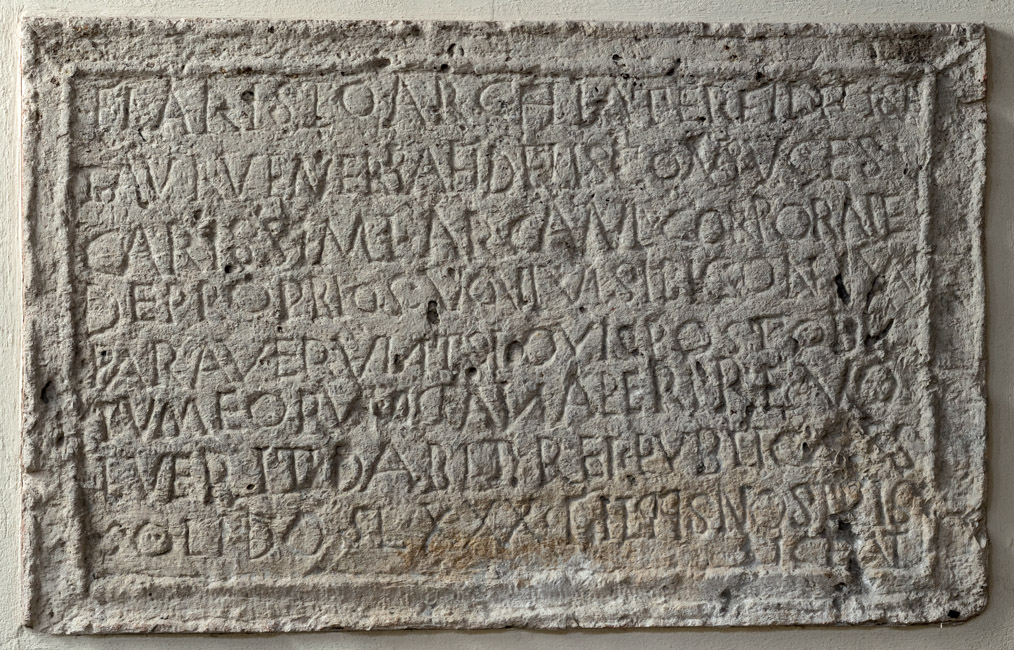
Dextrograde direction, horizontal layout, square module, irregular ductus, deep groove, left-aligned layout.
E strongly compressed laterally.
F with oblique upper arm, ascending towards the right.
N in EAN, l. 6, reversed.
INSCRIPTION
INTERPRETATIVE TRANSCRIPTION
Fl(avius) Aristo archiater fidelis e
=
t Aur(elia) Veneria fidelis, coniuges
carissimi, arcam corporale
de proprio suo vivi sibi coni
=
paraverunt (!). Si quis post obi
=
tum eorun (!)
ean (!) aperire vo
=
luerit, dabit rei publicae
solidos LXXX ite(m)q(ue) s(upra) nostris
liceat
APPARATUS CRITICUS
4-5. CON/PARAVERVNT, Bertolini 1876b, Bertolini 1877,
CIL V 8741,
ILS 7797,
ILCV 833, Lettich 1983
.
6. EORVM, Bertolini 1876b, Bertolini 1877,
CIL V 8741,
ILS 7797,
ILCV 833
EAM, Bertolini 1876b, Bertolini 1877,
ILS 7797,
ILCV 833
.
TRANSLATION
Flavius Aristo, faithful chief physician, and Aurelia Veneria, faithful, most dear spouses, while alive purchased the sarcophagus for their bodies at their own expense for themselves.
If anyone, after their death, wishes to open it, he shall pay 80 solidi to the Republic, and likewise, as [stated] above, let it be permitted to our [kin].
PEOPLE
Flavius Aristo
- NOMEN
- Flavius
- COGNOMEN
- Aristo
- GENS
- Flavia
- ORIGIN (of the name Aristo)
- greek
- GENDER
- male
- OCCUPATION
- civilian
- ROLE
- dedicator/deceased
- RELATIONSHIP
- husband (→ Aurelia Veneria)
Aurelia Veneria
- NOMEN
- Aurelia
- COGNOMEN
- Veneria
- GENS
- Aurelia
- ORIGIN (of the name Veneria)
- latin
- GENDER
- female
- OCCUPATION
- civilian
- ROLE
- dedicator/deceased
- RELATIONSHIP
- wife (→ Flavius Aristo)
Bibliography
| Bertolini 1876b, 130. |
| Bertolini 1877, 34, n. 45. |
| CIL V 8741 |
| ILS 7797 |
| ILCV 833 |
| Lettich 1983, 52-53, n. 9. |
- EDR
-
EDR097734
- Author of the record:
- Damiana Baldassarra
- Date:
- 25-11-2007
COMMENTARY
Flavius Aristo was an archiater, or physician, who, together with his wife Aurelia Veneria, commissioned the sarcophagus while still alive. Anyone who opened the sarcophagus would have to pay eighty solidi to the state, unless they were a relative (nostris liceat).
Regarding Aristo's role, Hoffmann suggests he was part of Theodosius' medical staff at the Battle of the Frigidus (Hoffmann 1969, 63). However, Lettich considers it more likely that he was an archiater popularis (local physician), given the choice of Concordia as a permanent burial site (Lettich 1983, 52-53).
From an onomastic perspective, the cognomen Aristo (from the Greek Ἄριστος) confirms the Greek origin of many specialized professionals of the period. Both the title and the substantial fine of eighty solidi point to a professional of good social standing and a solid economic base. Unlike Aristio, cited by Holder as a Celtic name (Holder 1896, 215), Aristo remains firmly linked to the Greek tradition (PLRE, 105).
The comminatory formula mentions the res publica instead of the fiscus, a rare occurrence in Concordia (EDR097857), to be understood, according to Mommsen, as a reference to the civitas Concordiensis ( CIL V, p. 1060).