The Inscription of Alexander
PHYSICAL DESCRIPTION
- Type
- Frontal panel of the sarcophagus.
- Material(s)
- Limestone.
- Execution
- Inscribed.
- Dimensions
- 59.5 × 110.5 cm
- Epigraphic Field
- 52 × 86.5 cm
- Letters Height
- 3.5-4 cm
Palaeographic comment
Dextrograde direction, horizontal alignment, slightly vertical module, regular ductus, triangular interpunction, shallow groove in the last two lines, left-aligned layout.
B with upper bowl smaller than the lower bowl;
F with crossbar shorter than the upper arm;
M with vertical lateral strokes in the first four lines, with oblique lateral strokes in the following lines;
N with vertical lateral strokes.
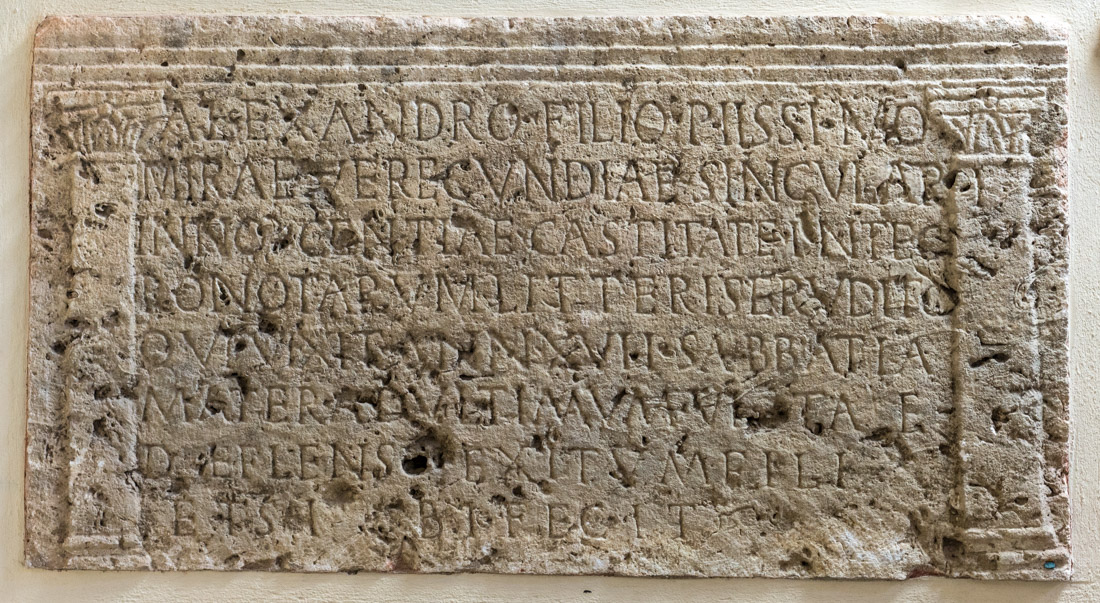
INSCRIPTION
INTERPRETATIVE TRANSCRIPTION
Alexandro filio piissimo
mirae verecundiae, singular‵i′<s>
innocentiae, castitat<a>e, integ
=
ro notarum litteris erudito,
qui vixit ạnn(is) XVII. Sabbatia
mater ad ultimum vitae
deflens exitum fili
et sibi fecit.
APPARATUS CRITICUS
1. PI<I>SSIMO,
ILCV 711
.
2. SINGVLAR(IS), Lettich 1983
.
3. FILII, Bertolini 1874a, Bertolini 1874b
.
TRANSLATION
To Alexander, most devoted son, of remarkable modesty, singular innocence, chastity, upright, learned in shorthand signs, who lived 17 years.
(His) mother Sabbatia, mourning the end of her son's life, made (this monument) also for herself.
PEOPLE
Alexander
- COGNOMEN
- Alexander
- ORIGIN (of the name Alexander)
- greek
- GENDER
- male
- OCCUPATION
- civilian
- ROLE
- deceased
- RELATIONSHIP
- son (→ Sabbatia)
Sabbatia
- COGNOMEN
- Sabbatia
- ORIGIN (of the name Sabbatia)
- jewish
- GENDER
- female
- OCCUPATION
- civilian
- ROLE
- dedicator/deceased
- RELATIONSHIP
- mother (→ Alexander)
Bibliography
| Bertolini 1874a, 31, n. 26. |
| Bertolini 1874b, 293, n. 18. |
| CIL V 8722 |
| ILS 7758 |
| ILCV 711 |
| Lettich 1983, 98, n. 61. |
- EDR
-
EDR097881
- Author of the record:
- Damiana Baldassarra
- Date:
- 21-11-2007
COMMENTARY
The mother Sabbatia dedicates the burial to her son, who died at seventeen and who was a notarum litteris eruditus. According to Leclercq, the deceased was a stonecutter or a stenographer (Leclercq 1927, 295). Zovatto shares this hypothesis (Zovatto 1949, 29), while Hoffmann believes he was a student (Hoffmann 1969, 64).
According to Lettich as well, Alexander was a student already well trained in the use of tachygraphic signs: otherwise the clearer term exceptor would have been used (Lettich 1983, 98).
The comminatory formula typical of Concordia's epigraphs is absent. The name Alexander is quite widespread in Concordia ( CIL V 1915; CIL V 1936; CIL V 1939).
There are no epigraphic attestations of other individuals named Sabbatia in Venetia, although the presence of a woman of the same name in Milan during late antiquity is attested (CIL V 6267; EDR138618).